


The Definitive Guide to Comparing Handheld Pool Cleaners

What Are Handheld Pool Cleaners — and Do You Need One?
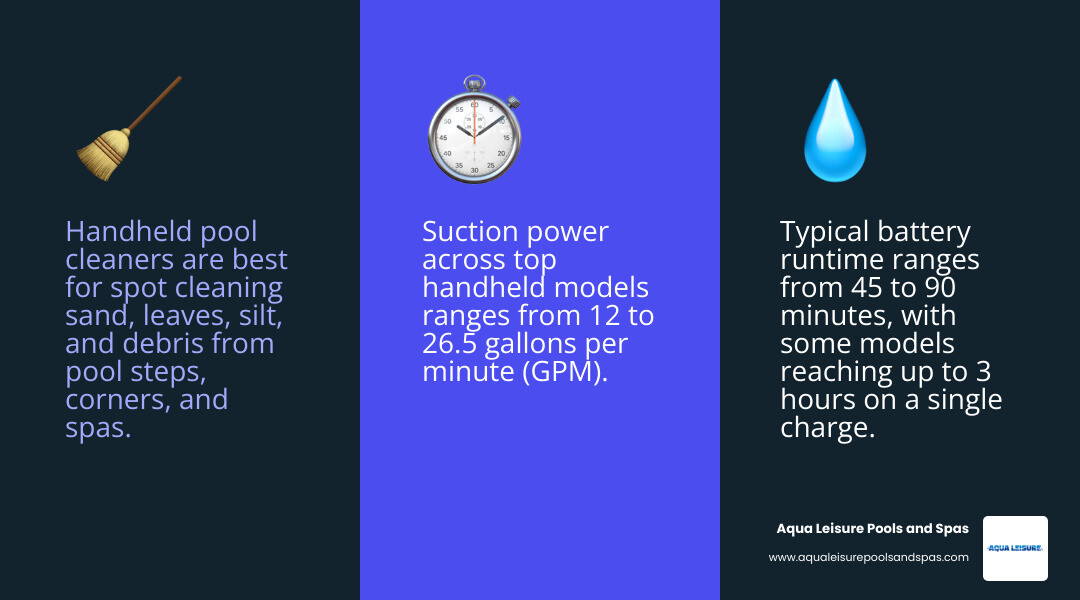
Handheld pool cleaners are compact, portable vacuums designed to spot-clean your pool, spa, or hot tub without setting up a full-sized automatic system. Here’s a quick overview of what they are and who they’re for:
- Best for: Spot cleaning sand, leaves, silt, and debris from pool steps, corners, and spas
- Main types: Cordless rechargeable, garden hose-powered (venturi), and manual suction-side
- Typical runtime: 45 to 90 minutes (some battery models reach up to 3 hours)
- Suction power: Ranges from 12 to 26.5 gallons per minute (GPM) across top models
- Works on: Above-ground pools, in-ground pools, hot tubs, spas, and inflatable pools
- Not a replacement for: Full robotic or automatic pool cleaners in large pools
Dragging out a heavy hose and priming your main filtration system just to clean up a small patch of sand or a few leaves — it’s one of those small frustrations that adds up fast over a swim season.
That’s exactly the problem handheld pool cleaners solve.
They’re lightweight, grab-and-go tools built for targeted cleaning. Whether you’re clearing debris off your hot tub steps before guests arrive or vacuuming fine desert sand that keeps settling in the deep end, a handheld vacuum gets the job done in minutes.
But not all handheld pool vacuums are equal. Runtime, suction strength, filter mesh size, and power source vary dramatically across models — and choosing the wrong one means frustration, not convenience.
This guide breaks down everything you need to know to pick the right one for your pool.
Similar topics to handheld pool cleaners:
Key Features to Evaluate When Comparing Handheld Pool Cleaners

When shopping for handheld pool cleaners, it is easy to get overwhelmed by marketing jargon. To cut through the noise, you need to understand how different models stack up across core technical specifications.
Evaluating a vacuum requires looking at its power source, suction metrics, filtration capacity, and physical design. For example, some models measure performance in Gallons Per Minute (GPM), while others use Gallons Per Hour (GPH). Understanding these differences helps you avoid buying an underpowered tool.
| Feature | Cordless Rechargeable Vacuums | Manual Hose-Powered / Venturi Vacuums |
|---|---|---|
| Power Source | Onboard lithium-ion battery | External garden hose water pressure |
| Setup Time | Instant (grab-and-go) | Medium (must connect and drag hose) |
| Debris Collection | Internal filter bag/basket | Attached mesh bag |
| Suction Strength | 12 to 26.5 GPM (consistent) | Dependent on household water pressure |
| Best For | Fine sand, silt, steps, and deep spots | Large leaves, twigs, and budget setups |
| Average Cost | Moderate to High | Budget-friendly |
Cordless Rechargeable vs. Manual Handheld Pool Cleaners
The first major decision you will face is choosing between a cordless rechargeable battery-powered vacuum and a manual vacuum that attaches to a garden hose.
Cordless rechargeable vacuums are completely self-contained. They operate without hoses or cords, relying on an internal motor powered by a rechargeable lithium-ion battery. Many pool owners prefer these models because they are highly convenient, starting up instantly when submerged. Premium options, like the 18V ONE+ Handheld Cordless Pool Vacuum Cleaner (Tool Only) with Floor Head, offer powerful, hose-free cleaning that makes quick work of dirty steps and tight corners.
Manual hose-powered vacuums (often called jet or venturi vacuums) do not use electricity. Instead, they attach directly to a standard garden hose. The water pressure flowing from the hose creates a “venturi effect” — a physical vacuum force that draws leaves and heavy debris off the pool floor and pushes them into an attached mesh collection bag.
While manual vacuums are highly affordable and never require charging, they do have downsides. They inject fresh, cold tap water directly into your pool during operation, which can alter your water chemistry and raise your water level. They are also less effective at catching ultra-fine silt, which often passes right through the standard mesh bags.
For those who want a completely hands-off experience for the pool floor but still need manual tools for steps, combining a handheld model with a robotic option like the X1P1 Cordless Robotic Pool Cleaner – Moolan provides the ultimate maintenance package. You can learn more about building your custom cleanup kit by exploring our guide on Pool Cleaning Tools Every Owner Needs and our comprehensive A Z Guide To Pool Cleaning Tools.
Suction Power and Filtration Capabilities of Handheld Pool Cleaners
When comparing the suction power of handheld pool cleaners, manufacturers typically list flow rates in either Gallons Per Minute (GPM) or Gallons Per Hour (GPH). For quick conversion, a vacuum rated at 15 GPM moves 900 GPH.
- Standard Suction (12 to 15 GPM): Perfect for hot tubs, spas, and light pool touch-ups.
- High Suction (18 to 26.5 GPM): Often referred to as “beast-level” suction, these vacuums can lift heavy sand, small pebbles, and dense leaf piles without clogging.
However, high suction is useless if the vacuum’s filter cannot retain the debris. Filtration capability is measured in microns or mesh sizes. Standard filters sit around 120 to 180 microns (ideal for leaves and bugs), while ultra-fine filters go down to 25 microns (ideal for fine sand, pollen, and dust).
The OGERY Cordless Handheld Pool Vacuum Rechargeable Pool Cleaner is a standout example of filtration versatility. It features interchangeable 180, 300, and 500-mesh filters. This allows pool owners to target large spring leaves with the coarser mesh, and then switch to the ultra-fine 500-mesh filter to trap microscopic silt during the height of summer.
Ensuring your vacuum has the right filter prevents you from blowing fine dirt right back into the pool water, which is a key concept covered in the Beginners Guide To Pool Filtration Systems and our deep dive on How To Maintain Your Pools Filtration System.
Battery Runtime, Charging Cycles, and Water Depth Ratings
If you choose a cordless model, pay close attention to battery specifications. Most cordless handheld pool vacuums use lithium-ion batteries that provide fade-free suction, meaning the power will not drop off as the battery drains.
- Runtime: Standard models offer 45 to 60 minutes of continuous runtime. Premium models can push past 90 minutes, and some specialized battery-powered wands can run up to 3 hours on a single charge.
- Charging Time: Fast-charging models can fully replenish their battery in 1.5 to 2 hours, while budget options may require up to 4 or 5 hours.
- Water Depth and Safety: Look for an IPX8 waterproof rating, which indicates that the unit is fully submersible. High-quality cordless vacuums can operate safely at depths of up to 13 feet.
- Water Sensors: To preserve battery life and protect the motor, many modern cordless vacuums feature built-in water sensors. These sensors automatically turn the motor on only when the vacuum is fully submerged and shut it off the moment it is pulled out of the water.
For larger pools, some owners step up to premium, automated cordless options like the Dolphin LIBERTY™ 300 Remote Pool Cleaner | Maytronics, which combines cordless battery convenience with automated floor-to-wall scrubbing.
Essential Accessories for Spot Cleaning and Hard-to-Reach Areas
To get the most out of your handheld vacuum, you need the right accessories.
- Telescopic Poles: While you can use a short handle to clean hot tubs and spa steps, you will need a telescopic pole to reach the floor of an in-ground pool. Most handheld vacuums feature a universal clip system compatible with standard pool poles.
- Brush Heads and Wide Inlets: A wide vacuum head (typically 10 to 13 inches) with integrated brushes is ideal for scrubbing algae or dirt off flat plaster or vinyl floors.
- Narrow Nozzles: For tight corners, pool steps, and the seams of above-ground pool liners, removing the wide floor head to reveal a narrow, high-velocity suction nozzle is the best way to extract stubborn debris.
Having these accessories on hand makes manual spot-cleaning highly efficient. For a complete breakdown of the equipment you should keep on hand, check out our Best Pool Vacuums For Inground Pools Survival Guide and our checklist of Items Every Pool Owner Should Have.
Maintenance Best Practices for Reusable Filters and Batteries
To extend the lifespan of your handheld pool vacuum and maintain strong suction, follow these simple maintenance habits:
- Rinse Filters Immediately: Do not let debris dry and harden inside your filter bag or cartridge. Always remove the filter, flush it thoroughly with a garden hose, and let it air dry.
- Dry the Charging Pins: Water is the natural enemy of electrical charging ports. Before plugging your vacuum in to recharge, dry the metal charging pins completely with a soft towel to prevent corrosion.
- Store Smart: Store your rechargeable vacuum and its battery in a dry, climate-controlled space. Avoid leaving them in a hot metal pool shed or exposed to direct sunlight, as extreme heat degrades lithium-ion batteries.
- Off-Season Care: During the winter months, do not let the battery sit completely dead. Charge the device at least once every three months to preserve battery health.
By avoiding common pitfalls, you can protect your investment for many seasons to come. Read more about protecting your pool equipment in our guide on Pool Maintenance Mistakes You Should Avoid and find answers to common questions in our Frequently Asked Questions About Pool Maintenance.
Choosing the Right Cleaning Tools for Your Pool Oasis
At the end of the day, a pristine swimming pool or spa is all about relaxation. Investing in the right handheld pool cleaners ensures that small debris cleanups remain a minor, five-minute task rather than a weekend chore.
Whether you are maintaining a compact backyard hot tub or a sprawling in-ground swimming pool, having a reliable spot-cleaning tool in your arsenal keeps your water inviting and crystal clear.
If you are ready to design your dream backyard oasis or need expert guidance on selecting the perfect maintenance tools, the team at Aqua Leisure Pools and Spas is here to help. We sell, install, and maintain high-quality pools and spas across Northeastern Pennsylvania.
Visit one of our convenient locations in Doylestown, Dickson City, Wilkes-Barre, or Bartonsville to explore our inventory, or take a deep dive into pool care by enrolling in our online Pool School. If you are planning a backyard upgrade, let us help you find the perfect match among our premium In-Ground Pools or durable Above Ground Pools. Contact us today to get started!
Posted by Aqua Leisure Pools in Pools