


The Ultimate Guide to Choosing the Right Automatic Pool Cleaner Hose
Why a Quality Hose for Pool Vacuum Makes All the Difference
A hose for pool vacuum is the critical link between your pool’s cleaning system and its filtration equipment. Here’s what you need to know:
Quick Guide to Pool Vacuum Hoses:
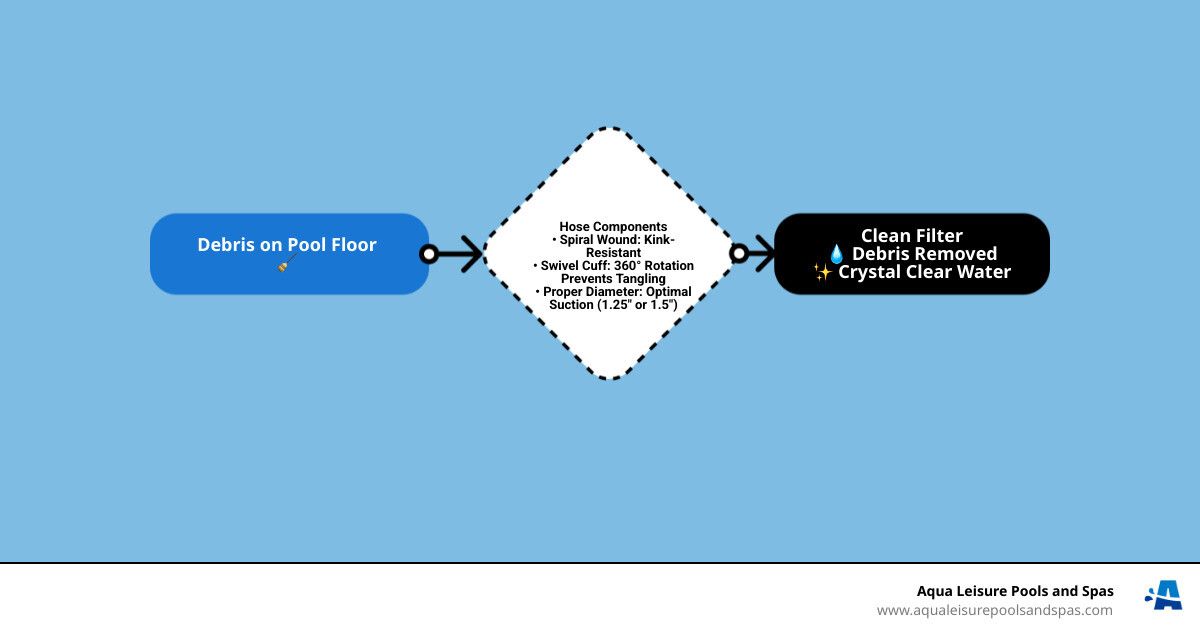
- Standard diameter: 1.5″ for in-ground pools, 1.25″ for above-ground pools
- Typical length: 25-50 feet (measure to reach your pool’s farthest point)
- Key features: Swivel cuffs prevent tangling, spiral-wound construction resists kinking
- Compatibility: Must fit your vacuum head, skimmer, and automatic cleaner brand
- Lifespan: 3-7 years with proper maintenance and storage
If you’ve ever struggled with a kinked hose that loses suction halfway through cleaning, or wondered why your pool vacuum suddenly stopped picking up debris, you’re not alone. The hose connecting your vacuum to your pool’s circulation system does more than just transport water—it’s responsible for maintaining consistent suction power and ensuring debris travels efficiently from your pool floor to your filter.
Your pool vacuum hose works hard. It flexes and bends as you maneuver around stairs and corners. It sits exposed to chlorine, UV rays, and temperature swings. And when it fails—through cracks, kinks, or poor connections—your entire pool cleaning routine grinds to a halt.
The good news? Choosing the right hose and maintaining it properly can transform your pool cleaning from a frustrating chore into a quick, efficient task. Whether you’re replacing a worn-out hose or setting up a new cleaning system, understanding what makes a quality vacuum hose will save you time, money, and headaches.
At Aqua Leisure Pools and Spas, we’ve seen how the right equipment makes pool ownership enjoyable rather than overwhelming. Your backyard oasis deserves a maintenance system that works as hard as you do.
Selecting the Best hose for pool vacuum Systems
When it comes to maintaining a pristine swimming environment, not all hoses are created equal. A high-quality hose for pool vacuum must be rugged enough to withstand the abrasive surfaces of a pool deck while remaining flexible enough to glide across the water. Selecting the right one requires a balance of material science and practical sizing.
Spiral Wound Construction and Durability
The most reliable hoses feature spiral wound construction. This design uses a reinforced skeleton that allows the hose to remain open even under the intense pressure of a 1.5-horsepower pump. Without this structural integrity, a hose could collapse or “crimp,” instantly killing your suction and potentially straining your pump motor.
Premium options, like those found at Aqua Leisure Pools and Spas, are often made from high-density polyethylene (HDPE) or heavy-gauge vinyl. These materials are chosen for their “crush-proof” nature. Additionally, because these hoses spend hours under the hot Pennsylvania sun in areas like Doylestown or Wilkes-Barre, they must be UV-resistant to prevent the plastic from becoming brittle and cracking over time.
The Importance of Swivel Cuffs
One of the most significant innovations in pool maintenance is the swivel cuff. Typically located on the end of the hose that attaches to the vacuum head, this cuff rotates 360 degrees. As you move your telescopic pole back and forth, the hose naturally wants to twist. A fixed cuff will cause the hose to coil and tangle, but a swivel cuff allows the hose to stay straight, ensuring you can reach every corner of the pool without fighting the equipment.
Matching Hose Diameters to Pool Types
Choosing the wrong diameter can lead to poor performance. If the hose is too narrow, the water flow is restricted; if it is too wide for your pump’s capacity, you won’t have enough velocity to pick up heavy debris.
| Hose Diameter | Primary Pool Type | Common Use Case |
|---|---|---|
| 1.25 Inches | Above-Ground Pools | Smaller pumps, manual vacuuming, and standard filter systems. |
| 1.5 Inches | In-Ground Pools | The industry standard for most residential manual and automatic cleaners. |
| 2.0 Inches | Commercial Pools | High-flow systems requiring massive debris removal. |
Understanding Different Types of hose for pool vacuum Options
The world of pool hoses extends beyond the standard blue tube. Depending on your specific cleaner—whether it’s a manual head or an automatic suction-side cleaner—you may need a specific configuration.
- Standard Spiral Hoses: These are continuous lengths (usually 25′ to 50′) used primarily for manual vacuuming. They are simple, cost-effective, and easy to store on a reel.
- Sectional Hose Sets: Many automatic pool cleaners use sectional hoses, often sold in 40-inch segments. This allows you to customize the length precisely to your pool’s dimensions. If one section gets a leak, you only replace that small piece rather than the whole 40-foot line.
- Leader Hoses: This is a shorter, often more flexible segment of hose that connects the main hose line to the vacuum head or cleaner. It acts as a buffer, providing better maneuverability and preventing the main hose from pulling the vacuum head off the floor.
- Backwash Hoses: It is important to note that backwash hoses are not vacuum hoses. Backwash hoses are flat, collapsible tubes used only for draining water during filter cleaning. They cannot handle suction.
For a deeper dive into the gear you need, check out this info about pool cleaning tools.
How to Measure and Install Your hose for pool vacuum for Efficiency
A common mistake is buying a hose that is far too long. While “more is better” sounds logical, an extra 20 feet of hose floating in the pool creates drag, tangles more easily, and requires your pump to work harder to prime the system.
Measuring Your Pool: To find the perfect length, measure the distance from the skimmer (or dedicated suction port) to the farthest corner of the pool. Add approximately 3 to 5 feet to account for the depth of the water. That is your ideal hose length. For example, if the farthest point is 35 feet away, a 40-foot hose is perfect.
The Installation Process:
- Attach the Vacuum Head: Connect the swivel cuff end of the hose to your vacuum head.
- Prime the Hose: This is the most critical step. Submerge the vacuum head and slowly push the hose vertically into the water, segment by segment. This forces all the air out. You’ll know it’s ready when water starts bubbling out of the free end.
- Connect to the Skimmer: Once the hose is full of water, keep the end submerged and quickly move it into the skimmer, attaching it to the vacuum plate or the suction hole at the bottom.
Proper priming is essential for maintaining what the CDC calls ‘healthy swimming’, as air in the system can prevent the filter from effectively removing bacteria and contaminants. For more tips on keeping your water pristine, see this info about keeping your pool clean.
Essential Accessories for Suction and Mobility
To get the most out of your hose for pool vacuum, several accessories can enhance performance:
- Skimmer Vacuum Plates: These allow you to vacuum through the skimmer basket. This means large debris like leaves are caught in the basket before they ever reach your pump, preventing clogs.
- In-Line Leaf Canisters: If your pool is prone to heavy leaf fall, these canisters sit between two hose sections and trap debris in a large mesh bag.
- Hose Weights: Often used with automatic cleaners, these small weights keep the hose submerged so it doesn’t float and pull the cleaner off the pool floor.
- Swivel Adapters: If your hose doesn’t have a built-in swivel, adding an adapter at the wall fitting can prevent the “coiling” effect that leads to tangles.
If you notice air bubbles in your return lines even after priming, you might have a suction-side leak. Learn more by reading this info about fixing pool leaks.
Maintenance and Storage Tips for Longevity
A high-quality hose is an investment, and with proper care, it can last for many seasons in the Northeastern Pennsylvania climate. Whether you are in Dickson City or Bartonsville, the transition from summer heat to winter cold can be brutal on plastics.
Proper Storage: When the cleaning is done, don’t leave the hose floating in the pool. Chlorine is a powerful oxidizer; over time, it will eat away at the hose material, making it “chalky” and brittle. Always remove the hose, rinse it with fresh water to remove chemical residue, and coil it loosely.
Coiling Techniques: Avoid tight coils. A tight coil creates “memory” in the plastic, meaning the next time you put it in the pool, it will want to spring back into a circle rather than laying flat. Aim for large loops about 3 to 4 feet in diameter.
Winterizing: In Pennsylvania, winterizing is non-negotiable. Before the first frost, ensure all water is drained from the hose. Water trapped inside can freeze and expand, causing the spiral ribs to split. Store your hose in a shed or garage, away from direct sunlight and extreme temperature fluctuations.
For more expert advice on seasonal care, visit our info about pool maintenance.
Troubleshooting Common Suction Issues
If your vacuum feels “weak,” the hose is often the primary suspect.
- Kinking and Tangling: This usually happens because the hose has developed a “memory” from being coiled too tightly. Laying the hose straight on a warm pool deck for a few hours can help the plastic relax and return to its original shape.
- Loss of Prime: If your pump starts sucking air, check the hose for tiny pinholes or cracks, especially near the cuffs. Even a tiny hole can break the vacuum seal.
- Cracked Cuffs: The cuffs are the most common failure point. If a cuff is loose, you can sometimes reseal it with specialized pool equipment adhesive, though replacement is usually more reliable.
Avoid common pitfalls by checking out this info about pool maintenance mistakes.
Above-Ground vs. In-Ground Hose Requirements
The requirements for your hose for pool vacuum change based on your pool’s construction.
- Above-Ground Pools: These typically use 1.25-inch hoses. Because the pumps on above-ground systems are generally less powerful, a lighter, more flexible hose is required. These often feature a “blow-molded” design that is very lightweight and easy to handle over the side of the pool.
- In-Ground Pools: These require heavy-duty 1.5-inch hoses. In-ground pool pumps are much stronger, and a flimsy hose would simply collapse under the pressure. These hoses also need to be more abrasion-resistant, as they often rub against concrete or stone coping.
Whether you are looking for a heavy-duty vinyl option or a flexible floating design, Aqua Leisure Pools and Spas has the expertise to help you choose. If you’re new to pool ownership, our pool school is a fantastic resource to get you up to speed.
From Scranton to Tannersville, we are here to ensure your pool remains the highlight of your summer. Stop by one of our locations in Dickson City, Wilkes-Barre, or Doylestown to find the perfect hose for your system and keep your backyard oasis sparkling all season long!
Posted by chris@enx2marketing.com in supplies