


A Pool Owner’s Practical Guide to Raising and Lowering Alkalinity

Step-by-Step Chemistry: How Do I Adjust the Alkalinity in My Pool?
To adjust the alkalinity in your pool, first test the water with a reliable kit, then add sodium bicarbonate to raise total alkalinity or muriatic acid (or sodium bisulfate) to lower it. Total alkalinity (TA) represents the concentration of dissolved carbonates, bicarbonates, and hydroxides in the water. It acts as a chemical shock absorber, buffering the water against wild swings in acidity. The standard ideal target for most swimming pools is 80 to 120 parts per million (ppm).
Reliable testing is essential before adding any chemical. While test strips provide a quick snapshot, a liquid drop titration test kit (such as a FAS-DPD kit) gives the precision needed for accurate dosing. Consistently testing your pool water prevents accidental over-treatment.
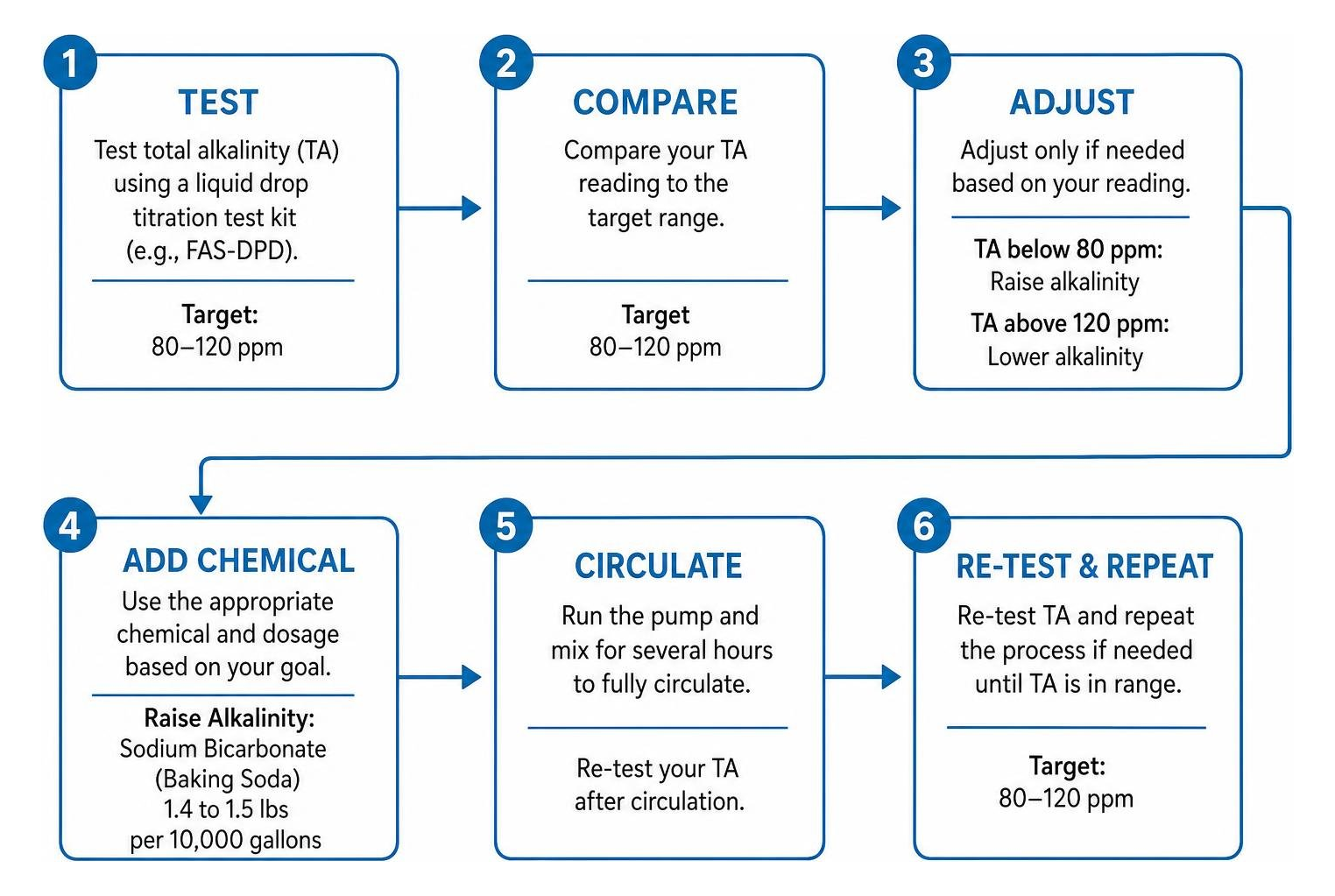
The table below outlines the standard chemical quantities required to adjust total alkalinity per 10,000 gallons of pool water:
| Desired Action | Primary Chemical | Approximate Dosage (per 10,000 Gallons) | Resulting TA Change |
|---|---|---|---|
| Raise Alkalinity | Sodium Bicarbonate (Baking Soda) | 1.4 to 1.5 lbs | +10 ppm |
| Lower Alkalinity | Muriatic Acid (31.45% / 20° Baumé) | 24.6 to 26 fl. oz. | -10 ppm |
| Lower Alkalinity | Sodium Bisulfate (Dry Acid) | 2.0 lbs | -10 ppm |
How Do I Adjust the Alkalinity in My Pool When It Is Too Low?
When total alkalinity drops below 80 ppm, water becomes corrosive and aggressive. Low TA causes “pH bounce,” where the pH level swings wildly with every rain shower, bather load, or chemical addition. Over time, acidic, unbuffered water etches plaster, corrodes metal ladder rails, eats heater heat exchangers, and irritates swimmers’ eyes.
To raise low alkalinity, use pure sodium bicarbonate (commonly known as baking soda or alkalinity increaser). Sodium bicarbonate raises alkalinity efficiently while only gently nudging the pH upward.
Follow these steps to raise alkalinity safely:
- Calculate the Requirement: Determine your pool volume. Adding 1.4 to 1.5 lbs of sodium bicarbonate per 10,000 gallons of water raises total alkalinity by roughly 10 ppm. For example, a 20,000-gallon pool needing a 20 ppm boost requires approximately 5.6 to 6 lbs of baking soda.
- Apply in Stages: Never dump a massive amount of chemical in at once. If your pool requires a large correction, stage the treatment by adding no more than 50% of the calculated total in a single application.
- Broadcast Across the Surface: Turn on the circulation pump. Slowly broadcast the dry sodium bicarbonate across the deep end or around the pool perimeter. Avoid dumping it into the skimmer or adding 10+ lbs at once, which can make filtration sluggish.
- Circulate and Retest: Let the filtration system circulate the water for 4 to 6 hours (or up to 8 hours for larger pools). Retest the water to assess your new baseline before adding any remaining dose.
Understanding how pool chemicals work allows you to balance water without creating secondary chemistry issues. Always follow basic pool chemical safety and storage rules: keep dry chemicals stored in a cool, dry place away from direct sunlight and liquid acids.
How Do I Adjust the Alkalinity in My Pool When It Is Too High?

High alkalinity (above 120 ppm, and especially over 150 ppm) creates the opposite set of problems. It locks the pH high and makes lowering it difficult. High TA leads to calcium scale formation on pool walls, plumbing lines, and salt chlorine generator cells, alongside persistent cloudy pool water. High pH and TA also severely diminish sanitizer efficiency. At a high pH of 8.0, chlorine is only about 15% active as hypochlorous acid, compared to roughly 73% active at pH 7.0.
To bring high alkalinity down, use liquid muriatic acid (hydrochloric acid) or dry acid (sodium bisulfate). To safely lower your pool’s alkalinity:
- Calculate the Dose: Adding 24.6 to 26 fluid ounces of 31.45% muriatic acid—or 2.0 lbs of sodium bisulfate—per 10,000 gallons reduces total alkalinity by approximately 10 ppm.
- Limit Reductions: Limit your treatment to a maximum reduction of 20 ppm per session to avoid crashing your pH into dangerously acidic territory.
- Use Protective Gear (PPE): Always wear chemical-resistant gloves, safety goggles, and closed-toe shoes. Acid fumes are potent, so work upwind in an open area.
- Pre-Dilute and Add: Fill a 5-gallon plastic bucket with pool water first, then slowly add the measured acid into the water (remember: never add water to acid, as it can cause a thermal reaction or splashback). Pour the diluted solution slowly into the deep end in front of a return jet with the pump running.
- Circulate and Restrict Swimming: Run the circulation pump for 4 to 6 hours. Keep swimmers out of the pool for at least 4 to 8 hours after adding acid, and verify the pH is at least 7.2 before re-entry.
Lowering Alkalinity Without a pH Crash Using Aeration
One of the trickiest parts of pool chemistry is that acid lowers both total alkalinity and pH simultaneously. If your pool has a TA of 160 ppm and a pH of 7.6, adding enough acid to lower the TA to 100 ppm will drive the pH down to an unacceptably low level (below 7.0). Adding sodium carbonate (soda ash) to push the pH back up would immediately raise the alkalinity again, putting you back at square one.
The solution is the acid-and-aerate cycle, a proven method for lowering alkalinity without crashing pH.
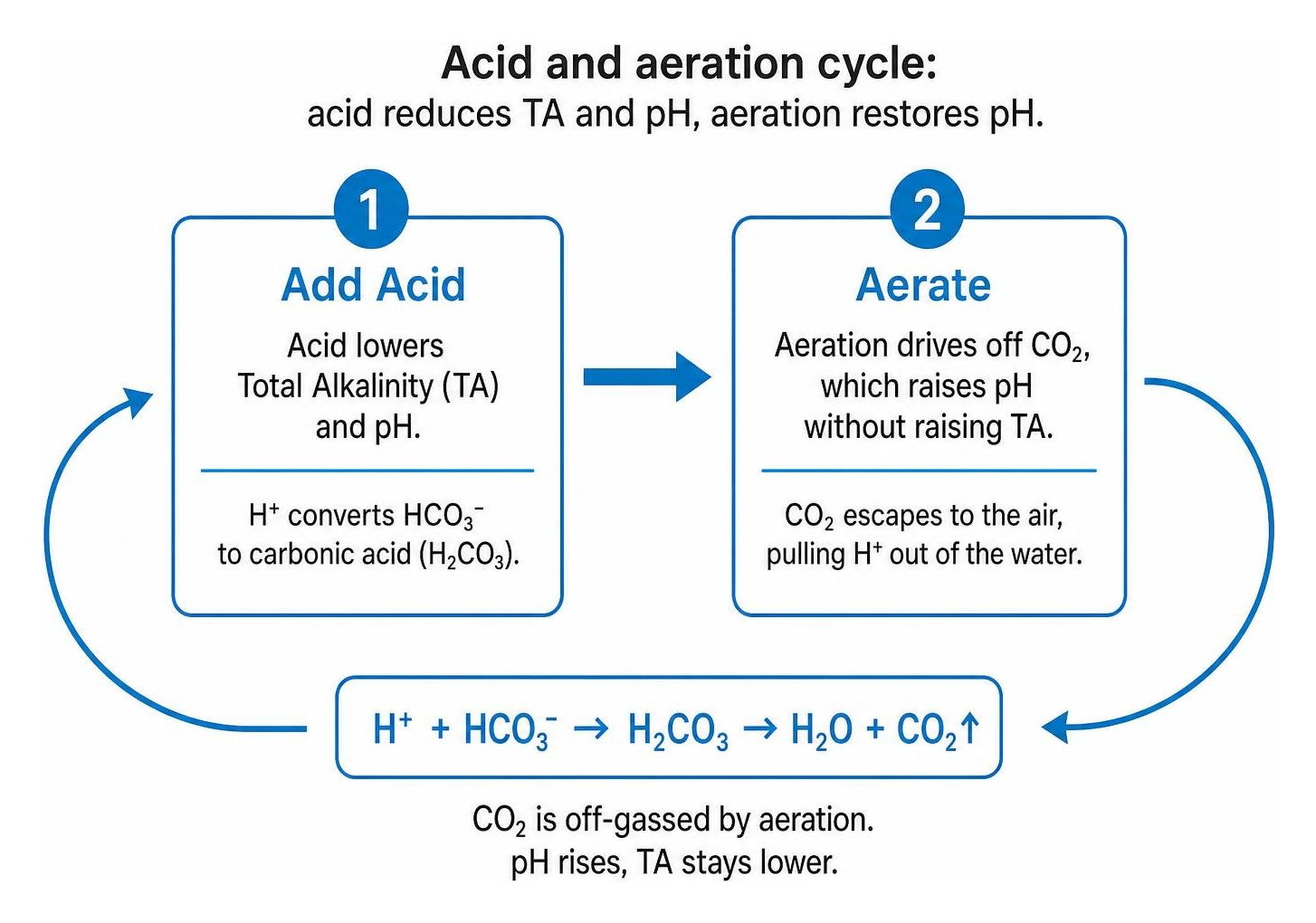
When acid is added to pool water, it converts bicarbonate ions into aqueous carbonic acid ($H2CO3$), which breaks down into water and dissolved carbon dioxide ($CO_2$). By aggressively aerating the pool water, you force this dissolved carbon dioxide gas to off-gas into the atmosphere:
$$H^+ + HCO3^- \rightarrow H2CO3 \rightarrow H2O + CO_2\uparrow$$
This off-gassing pulls hydrogen ions out of the water, raising the pH naturally without raising total alkalinity.
How to Aerate Your Pool:
- Point your return eyeballs toward the surface to create bubbling and surface turbulence.
- Turn on deck jets, water fountains, sheer descents, or spillover spas.
- Run your pump and water features for 8 to 24 hours after an acid addition until the pH naturally climbs back into the safe 7.4 to 7.6 zone.
- Each acid-aerate cycle safely reduces total alkalinity by 10 to 15 ppm while keeping pH stable.
Managing Long-Term Pool Water Balance and Preventing Fluctuations
Maintaining steady alkalinity prevents constant chemical adjustments. Understanding what alkalinity is and how it affects your pool helps identify the environmental factors that alter your levels:
- Heavy Rainfall: Rainwater is naturally acidic (pH 5.0 to 5.5) and contains zero alkalinity. Heavy rainstorms dilute pool water and steadily pull TA down.
- Trichlor Chlorine Pucks: Stabilized 3-inch chlorine tablets have a low pH (around 2.8 to 3.0). Using them continuously gradually depletes total alkalinity.
- Fill Water Quality: Topping off the pool with well water or municipal tap water introduces its own baseline chemistry. Hard limestone water can drive TA upward, while soft or treated water can lower it.
- Bather Waste and Debris: Organic matter, sweat, and oils introduce weak acids that consume alkalinity over time.
Common Alkalinity Mistakes to Avoid
- Chasing pH before TA: Adjusting pH without balancing alkalinity first leads to unstable readings.
- Using Soda Ash for Alkalinity: Soda ash drastically spikes pH while providing relatively little alkalinity increase; always use sodium bicarbonate for TA corrections.
- Dumping Acid in One “Slug”: The myth of pouring acid in a concentrated column to “only burn off alkalinity” does not work and risks damaging plaster or vinyl floors. Always dilute and circulate.
- Over-Correcting: Adding massive single chemical doses causes rebound effects and erratic swings.
The Critical Relationship Between Alkalinity and pH
Total alkalinity and pH are closely linked partners in pool chemistry. While pH levels measure the current concentration of active hydrogen ions on a scale of 0 to 14, alkalinity measures the total reserve of alkaline buffers available to neutralize future acids.
Maintaining pH in the 7.4 to 7.6 range ensures swimmer comfort, prevents eye redness, and protects equipment from scale or corrosion. More importantly, keeping TA between 80 and 120 ppm ensures that the pH stays anchored. For a deeper look into the chemistry of water balance, review these pH and alkalinity fundamentals.
When balancing your water from scratch, always follow the proper order of operations:
- Total Alkalinity (balance first to establish the buffer)
- pH (adjust second, once TA is stable)
- Calcium Hardness (adjust to protect plaster and liners)
- Sanitizer / Free Available Chlorine
Pool Surface Variations and Professional Water Care
Different pool designs and equipment setups perform best at slightly different alkalinity ranges:
- Plaster and Gunite Pools: Plaster pools benefit from a total alkalinity range of 100 to 120 ppm. The higher bicarbonate level prevents the water from leaching calcium carbonate directly out of the plaster finish.
- Vinyl Liner and Fiberglass Pools: These non-porous surfaces are not at risk of calcium leaching, performing best at 80 to 100 ppm. Lower TA makes it easier to keep pH from creeping upward.
- Saltwater Chlorine Generator Pools: Saltwater pools generate tiny amounts of sodium hydroxide as a byproduct of chlorine production, which naturally pushes pH up over time. Maintaining a lower total alkalinity of 60 to 80 ppm in saltwater systems helps keep pH steady and reduces scale formation inside the electrolytic cell.
For homeowners looking to streamline seasonal maintenance routines, systems like E-Z Pool chemicals offer simplified water care options. If you ever run into stubborn water balance problems, scale buildup, or persistent chemistry swings, visit one of our Aqua Leisure Pools and Spas showrooms in Doylestown, Dickson City, Wilkes-Barre, or Bartonsville for expert advice and water care solutions across Northeastern Pennsylvania.
Posted by Aqua Leisure Pools & Spas in Pools