


How to Detect Pool Leaks the Right Way

Why Knowing How to Detect Pool Leaks Can Save You Thousands
Detect pool leaks early and you can avoid costly structural damage, skyrocketing water bills, and endless chemical top-ups.
Here’s a quick way to tell if your pool is leaking:
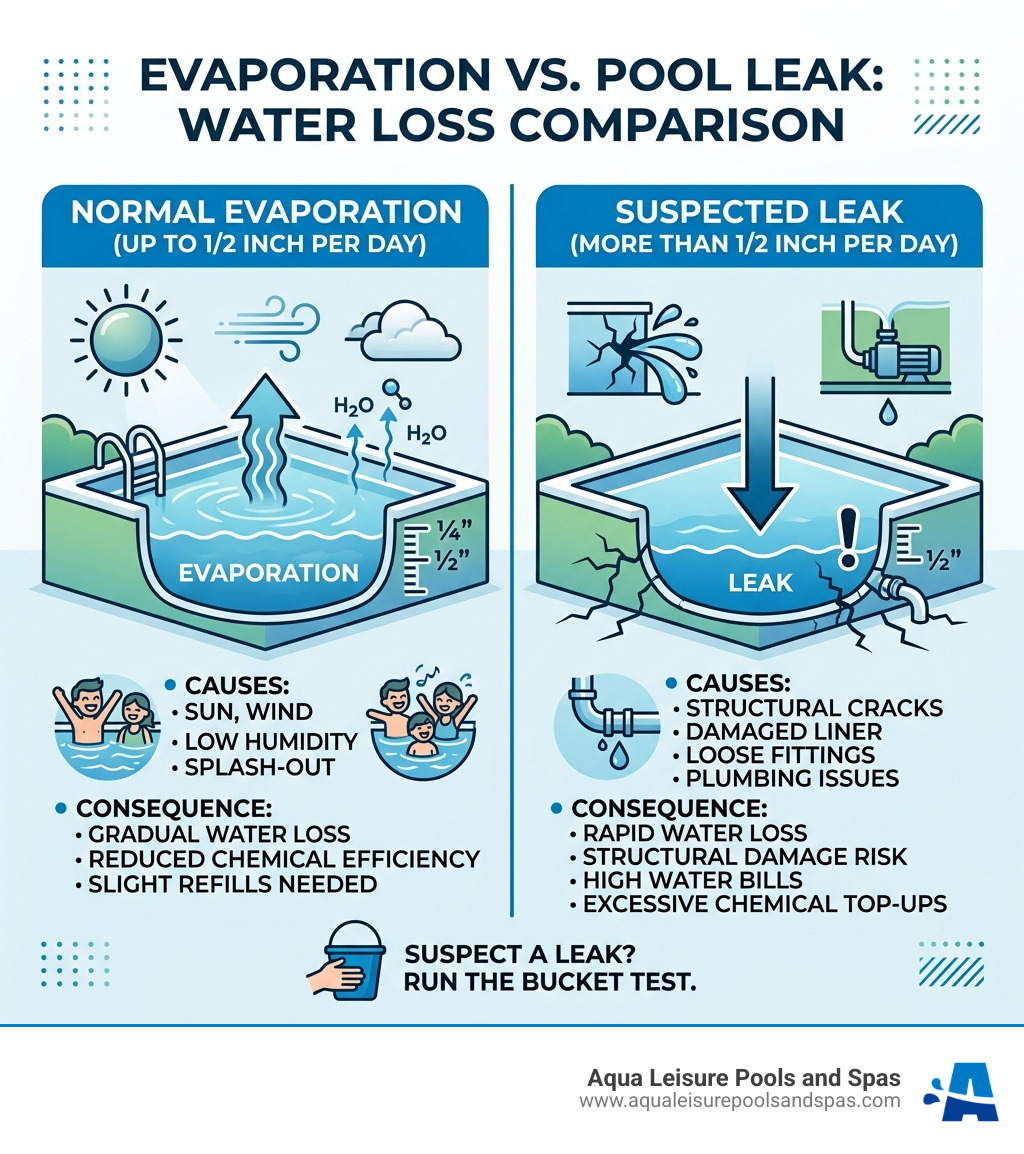
- Check your daily water loss — losing more than ½ inch per day is a red flag
- Run the bucket test — place a filled bucket on a pool step, mark both water levels, wait 24 hours; if the pool drops more than the bucket, you likely have a leak
- Look for visible signs — wet spots around equipment, unexplained cracks, or sudden chemical imbalances
- Use dye — squirt food coloring near suspected areas with the pump off; if it gets sucked in, you’ve found your leak
That’s the short answer. But where the leak is hiding — and how to fix it — can be much more complex.
Pools naturally lose some water every day. Evaporation, splash-out, and humidity all play a role. A typical pool loses between ¼ and ½ inch of water daily just from normal evaporation. Wind and low humidity can push that even higher.
But if you’re regularly adding water and still watching the level drop? That’s not evaporation. That’s a leak — and it’s costing you money and potentially damaging your backyard investment every single day it goes undetected.
The good news: many pool leaks can be found at home with simple tests before you ever need to call a professional.
How to Detect Pool Leaks: A Step-by-Step Guide
When the calendar turns to April 2026, pool owners in Northeastern Pennsylvania are often eager to pull back the covers and jump into the swimming season. However, discovering a dropping water line can quickly dampen that excitement. Before panic sets in, it is important to understand why is my pool losing water.
The first step in any DIY diagnosis is to distinguish between environmental factors and a physical hole in your system. Evaporation is a sneaky culprit; on a windy day with low humidity, your pool can easily lose a quarter-inch of water without a single leak being present. However, if the loss exceeds half an inch daily, or two inches over a week, you are likely facing a mechanical or structural issue. Following a how to find a leak in a pool in 6 steps methodology allows you to systematically rule out the easy fixes before moving to more advanced detection.
The Bucket Test: Is it Evaporation or a Leak?
The bucket test is the gold standard for homeowners to detect pool leaks. It works by creating a “micro-environment” that experiences the same evaporation as your pool but cannot lose water through a leak.
To perform this test, you will need a standard 5-gallon plastic bucket and some waterproof tape. Follow these steps:
- Bring the pool to normal level: Ensure your pool is filled to its usual operating height.
- Fill the bucket: Fill a bucket with pool water to about one inch from the top.
- Place the bucket: Set the bucket on the first or second step of the pool. It should be immersed about 5-6 inches into the pool water. This ensures the water inside the bucket stays at the same temperature as the pool water, which is vital for an accurate evaporation comparison.
- Mark the levels: Use your tape to mark the water level inside the bucket. Then, mark the pool’s water level on the outside of the bucket.
- Wait 24 hours: Turn off the auto-fill device if you have one. Ensure no one (including pets) swims in the pool during this time to avoid splash-out.
- Compare: After 24 hours, check the marks. If the water level in the pool has dropped significantly more than the level inside the bucket, you have a leak.
Statistics show that even a 1/8-inch difference in the bucket test can equate to approximately 500 gallons of water lost daily. Understanding the types of pool leaks—whether they are in the shell, the plumbing, or the equipment—is the next step once the bucket test confirms a problem exists.
How to Use Dye to Detect Pool Leaks
Once you’ve confirmed a leak exists, you need to pinpoint its location. This is where the dye test comes in. You don’t need fancy equipment; a simple bottle of dark food coloring or a specialized pool leak detection dye will do the trick.
According to pool leak detection: how to quickly find the leak yourself, the key to a successful dye test is “still water.” Turn off your pump and all water features (like waterfalls or deck jets) at least 30 to 60 minutes before testing. This allows the water to become perfectly calm.
Start by inspecting common “suspect” areas:
- The Skimmer: Squirt a small amount of dye around the opening of the skimmer. If the dye is sucked into a crack between the plastic skimmer and the pool wall, you’ve found a leak.
- Pool Lights: The conduit for the light cord is a frequent offender. Squirt dye near the light housing to see if it disappears behind the fixture.
- Fittings and Returns: Check around the return jets and the main drain.
- Visible Cracks: If you see a crack in the plaster or a tear in the vinyl, move the dye near it. If the dye flows into the crack like a current, the leak is confirmed.
Identifying Signs of Structural and Equipment Leaks
While the bucket and dye tests are excellent for finding holes in the pool vessel, some leaks hide in plain sight at the equipment pad. You should regularly perform inground pool leak detection by walking around your pool’s “engine room.”
Common signs of leaks include:
- Soggy Ground: If you notice a patch of grass that is always swampy or “squishy” near the pool or the pump, there is likely an underground pipe leak or a failing seal.
- Air Bubbles: If you see air bubbles returning through the jets while the pump is running, you likely have a “suction-side” leak. This means air is being pulled into the pipes, often through a loose pump lid O-ring or a cracked fitting.
- Chemical Instability: If you find yourself constantly adding chlorine or stabilizer (CYA) but the levels won’t stay up, you might be losing treated water and replacing it with fresh, untreated water.
- High Water Bills: An auto-fill device is convenient, but it can mask a massive leak. Check your utility bill for unexpected spikes in water usage.
- Cracked Tiles or Coping: Structural shifts can cause tiles to pop or the concrete “coping” around the edge to crack, which often leads to water escaping behind the pool wall.
Professional Solutions and Long-Term Prevention
By April 2026, pool technology has advanced, but the basics of maintenance remain the foundation of a leak-free backyard. Preventing a leak is always more cost-effective than fixing one. This involves maintaining proper water chemistry to prevent the degradation of seals and plaster, as well as regular inspections of the skimmer and pipes. For a deep dive into these components, see the complete guide to repairing a leaky pool skimmer and pipe.
When to Hire a Professional to Detect Pool Leaks
Sometimes, DIY methods reach their limit. If you’ve performed the bucket test and confirmed a leak, but the dye test isn’t revealing the source, the problem is likely underground. This is when you need a professional.
Experts use specialized tools that the average homeowner doesn’t have in their garage:
- Pressure Testing: This involves plugging the lines and using air or water pressure to see if a specific pipe can hold its “prime.”
- Sonic Detectors: These are ultra-sensitive microphones that can “hear” the sound of water escaping a pipe through several feet of dirt or concrete.
- Electric Charge Testing: Specifically for vinyl liner pools, this method uses a small electric charge in the water. The electricity seeks the ground through any hole in the liner, and a directional receiver helps the technician find the exact puncture.
| Feature | DIY Detection | Professional Detection |
|---|---|---|
| Cost | Very Low (Price of a bucket/dye) | Moderate to High |
| Accuracy | Good for visible leaks | Excellent for all leaks |
| Equipment | Household items | Sonic/Pressure tools |
| Time | 24-48 hours | 1-3 hours |
| Best For | Confirmation & Surface leaks | Underground/Hidden leaks |
Repairing Minor Leaks and Maintenance Strategies
If you find a small leak, you might be able to handle it yourself. For vinyl liners, underwater patch kits are available that allow you to apply a patch without draining the pool. In fact, you should never drain a pool completely to fix a leak without professional guidance, as this can cause the walls to collapse or a vinyl liner to shrink and become brittle.
For concrete or gunite pools, waterproof epoxy putty can be used to fill small cracks or gaps around the skimmer faceplate. However, these are often temporary fixes. For long-term health, you must focus on the Langelier Saturation Index (LSI). If your water is too “hungry” (aggressive), it will actually eat away at the plaster and the rubber O-rings in your pump, leading to leaks.
Education is your best defense. Many homeowners find that attending pool school helps them understand the delicate balance of their pool’s ecosystem, making it easier to spot trouble before it becomes a disaster.
Conclusion: Protecting Your Backyard Oasis
A pool is more than just a basin of water; it’s a place for family memories and relaxation. Whether you are in Doylestown, Dickson City, Wilkes-Barre, or Bartonsville, keeping your pool in top shape requires a watchful eye. By knowing how to detect pool leaks using the bucket and dye tests, you can take control of your maintenance and protect your investment.
If the leak proves to be elusive or requires professional repair to your underground plumbing, don’t wait. Small leaks can lead to sinkholes or foundation damage if left unaddressed. For all your pool needs—from installation to expert maintenance—trust the team that helps you create and maintain your dream backyard.
Ready to get back to worry-free swimming? Visit Aqua Leisure Pools and Spas today for expert advice and professional service across Pennsylvania.
Posted by chris@enx2marketing.com in Pools