


How to Turn Your Above Ground Pool into a Giant Hot Tub
Why Above Ground Pool Heaters Are the Key to a Year-Round Backyard Oasis
Above ground pool heaters are the single best way to extend your swimming season, keep your water warm on cool evenings, and turn your backyard pool into something that feels a lot like a private hot tub.
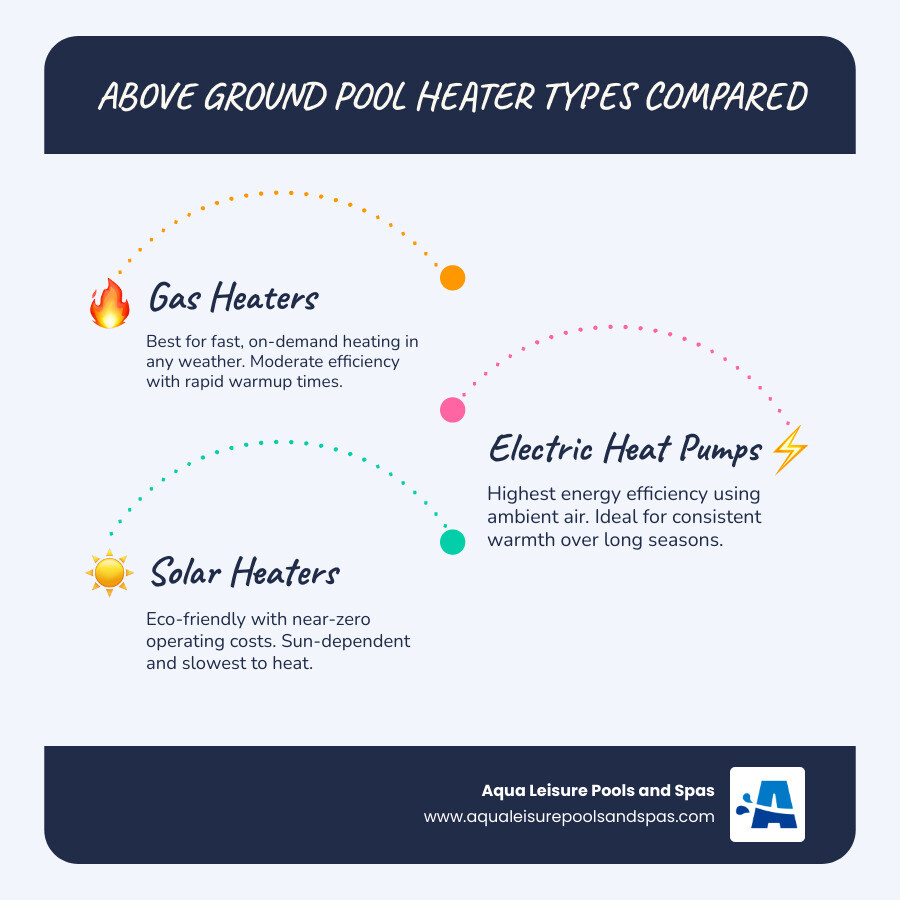
Here’s a quick look at the main types to help you choose:
| Heater Type | Best For | Efficiency | Heating Speed |
|---|---|---|---|
| Gas (Natural/Propane) | Fast, on-demand heat | Moderate | Fastest |
| Electric Heat Pump | Consistent, energy-efficient warmth | Highest | Moderate |
| Solar | Low-cost, eco-friendly heating | Variable (sun-dependent) | Slowest |
Most above ground pool owners fall into one of three camps:
- You want fast heat when you need it — gas is your answer
- You want low running costs over a long season — go with a heat pump
- You want near-zero operating costs and don’t mind slower results — solar does the job
The reality is that without a heater, most above ground pools in North America are only comfortable for swimming a few months a year. With the right heater, you can realistically open your pool in early spring and keep it going well into fall.
Imagine jumping into warm water on a crisp October evening. That’s not a fantasy — it’s what the right above ground pool heater makes possible.
Choosing the Best above ground pool heaters for Your Backyard
When residents in Northeastern Pennsylvania look to upgrade their backyard experience, the sheer variety of above ground pool heaters can feel overwhelming. Choosing the right one isn’t just about picking a brand; it’s about matching the technology to how you actually use your pool. Are you a “weekend warrior” who wants the water hot by Saturday morning, or do you prefer a consistent 82 degrees from May through September?
The climate in areas like Scranton, Wilkes-Barre, and Doylestown plays a massive role in this decision. Since our spring and fall air can be quite crisp, a heater that struggles in 50-degree weather might not give you the season extension you’re looking for.
To help you navigate these waters, it’s helpful to understand what type of pool heater is best for you based on technical specifications and local environmental factors. For instance, high-performance units like the AquaPro Heat Pump are engineered with commercial-grade titanium heat exchangers to handle the variable water chemistry and temperatures common in the Northeast.
Gas Heaters: The Fast Track to a Hot Tub Experience
If you want your pool to feel like a giant hot tub on demand, gas is the undisputed champion. Whether you utilize natural gas or propane, these heaters work by burning fuel to create a flame that heats a copper or cupro-nickel heat exchanger.
The primary advantage here is speed. While other methods might take days to raise the temperature significantly, a powerful gas heater can increase the water temperature by several degrees in just a few hours. This makes them ideal for pool owners who don’t want to run a heater 24/7 but want the flexibility to heat the pool for a specific party or a sudden warm weekend.
Modern units, such as the Universal H-Series H400 Low NOx Pool Heater, are designed with the environment in mind. “Low NOx” refers to reduced nitrogen oxide emissions, making them a more eco-friendly choice for homeowners in Pennsylvania who still want the raw power of gas. These units are often built with rust-resistant “PolyTuf” coatings and wind-resistant designs, ensuring they can stand up to the unpredictable weather in the Lehigh Valley and beyond.
Electric Heat Pumps: Energy-Efficient above ground pool heaters
For those who prioritize long-term savings and energy efficiency, electric heat pumps are the modern gold standard. Unlike gas heaters that generate heat, heat pumps transfer heat. They pull warmth from the surrounding ambient air, compress it to increase the temperature, and transfer that heat into your pool water.
Because they move heat rather than create it, they are incredibly efficient. Many high-quality heat pumps boast a high Coefficient of Performance (COP). For every $1 of electricity you put in, you might get $5 or $6 worth of heat out. This makes them significantly cheaper to operate than traditional electric resistance heaters or gas units over a full season.
Many above-ground-pools in our region now utilize inverter technology. An inverter heat pump doesn’t just click “on” or “off.” Instead, it adjusts its speed to maintain a precise temperature, much like a dimmer switch on a light. This reduces wear and tear and keeps your electric bill predictable. However, keep in mind that since they rely on air temperature, they lose efficiency when the air drops below 50-55°F.
Solar Heating Solutions: The Eco-Friendly above ground pool heaters
If you have a yard that gets plenty of direct sunlight, solar heating is essentially “free” energy. Solar collectors—usually large black panels or coils—are installed where they can soak up the sun. Your pool pump sends water through these collectors, where it is warmed by the sun before returning to the pool.
The benefits are clear: zero operating costs after the initial purchase and a very low carbon footprint. Systems like the Above Ground Solar Heating System can reliably raise your pool temperature by 5 to 10 degrees.
The trade-off is dependency. If it’s a cloudy week in Bloomsburg or Allentown, your pool isn’t getting any warmer. Solar is best used as a supplement to a primary heater or as a “boost” for owners who are patient and want to keep their utility bills at zero.
Sizing Your Heater: BTUs and Pool Volume
Buying a heater that is too small for your pool is a recipe for frustration. You’ll spend money on energy, but the water will never quite reach that “hot tub” feel. Heater capacity is measured in BTUs (British Thermal Units).
To size your heater correctly, you must first calculate your pool water volume. For a round pool, the formula is: 3.14 x radius x radius x average depth. For a rectangular pool, it’s simply length x width x average depth.
Once you know how many gallons you’re heating, consider your goals. A 50,000 BTU heater might suffice for a small pool in a mild climate, but for medium to large above-ground-pools, you’ll likely want something in the 75,000 to 125,000 BTU range to combat the cooler Pennsylvania nights. The larger the surface area of your pool, the faster it loses heat to the air. If you live in a particularly windy area like the Poconos, you should always “size up” to compensate for that heat loss.
Maximizing Efficiency and Maintenance for Long-Term Warmth
Installing a heater is only half the battle. To truly turn your pool into a giant hot tub without breaking the bank, you need to focus on heat retention. Without a strategy to keep the heat in, you are essentially trying to heat the great outdoors.
At Aqua Leisure Pools and Spas, we emphasize that a heater and a cover are a partnership. Whether you are opening your pool in the spring or preparing for the first frost, managing your equipment properly will save you thousands of dollars over the life of your pool.
The Role of Solar Covers and Blankets
Think of a solar cover as a lid for your hot tub. According to the Department of Energy, a pool cover can reduce heating costs by over 80%. This is because the primary way pools lose heat is through evaporation.
There are several options for heat retention:
- Solar Blankets: These look like heavy-duty bubble wrap. They float on the surface, trapping heat from the sun during the day and preventing it from escaping at night.
- Solar Rings: These are individual circular discs that are easier to remove than one giant blanket. They are a great middle-ground for people who find blankets cumbersome.
- Liquid Solar Blankets: A specialized chemical is added to the water that creates a microscopic, one-molecule-thick layer on the surface. While invisible and safe to swim in, it significantly reduces evaporation.
For those looking at premium above ground pool options, integrating a high-quality cover is the smartest move you can make to ensure your heater isn’t working overtime.
Professional Installation and Maintenance Essentials
While it might be tempting to treat an above ground heater as a “plug-and-play” appliance, professional installation is critical for safety and efficiency. Gas heaters require precise gas line sizing and proper ventilation to prevent the buildup of dangerous fumes. Electric heat pumps often require a dedicated circuit and a specific electrical load that standard outdoor outlets can’t handle.
Furthermore, your heater needs to be integrated into your existing plumbing. If the flow rate from your pump is too high or too low, the heater won’t function correctly. This is why many homeowners seek expert pool equipment repair and installation in areas like Tannersville and Stroudsburg.
Maintenance is the final piece of the puzzle. To ensure your heater lasts 10 to 20 years:
- Clear Debris: Ensure leaves and mulch don’t pile up around the base of the unit, which can restrict airflow or cause rust.
- Check Chemistry: Imbalanced pH or high chlorine can corrode the heat exchanger from the inside out.
- Winterize Properly: In Pennsylvania, you must winterize your pool heater by draining all water from the internal pipes. If water freezes inside the heat exchanger, it will crack, leading to an expensive replacement.
If you’re ready to stop shivering and start swimming, the best next step is to see these units in person. Visit our pool showrooms in Dickson City, Wilkes-Barre, or Doylestown to speak with an expert who can help you size the perfect heater for your specific backyard oasis. Turning your above ground pool into a warm, inviting retreat is easier than you think—and your family will thank you for the extra months of fun!
Posted by chris@enx2marketing.com in Pools