


Stop Burning Cash: The Real Cost to Heat a 15000 Gallon Pool
Understanding Your Pool Heating Investment
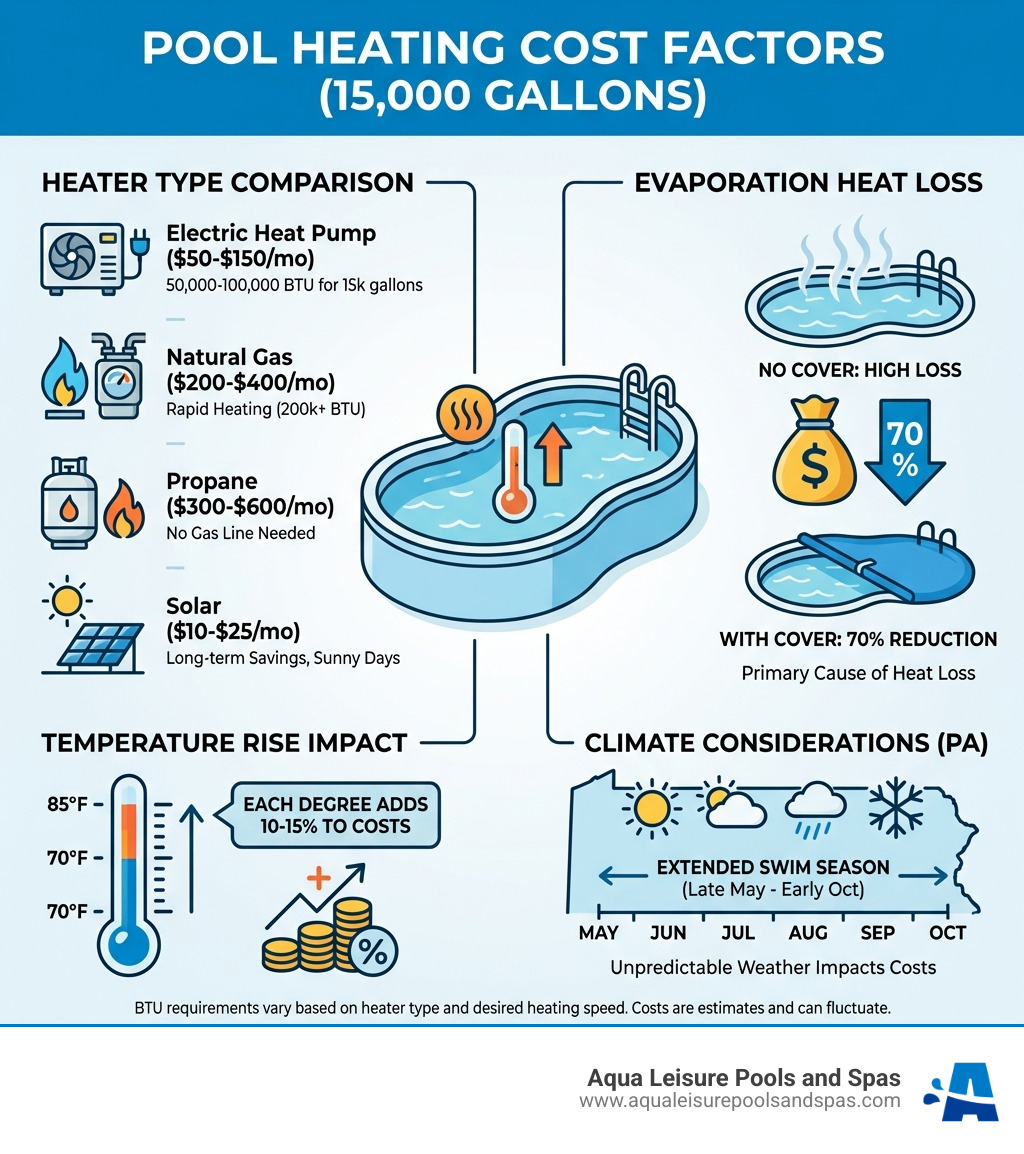
The cost to heat a 15000 gallon pool varies dramatically based on your heating method and usage patterns. Here’s what you need to know:
Quick Cost Overview for a 15,000 Gallon Pool:
| Heater Type | Monthly Operating Cost | Best For |
|---|---|---|
| Electric Heat Pump | $50-$150 | Season extension, moderate climates |
| Natural Gas | $200-$400 | Quick heating, frequent use |
| Propane | $300-$600 | Areas without gas lines |
| Solar | $10-$25 | Long-term savings, sunny locations |
You’re probably staring at your pool right now, wishing you could jump in—but the water’s too cold. Maybe you’ve thought about adding a heater but worry about energy bills spiraling out of control. That concern is valid. Research shows that most pool owners underestimate heating costs by 40-60%.
A 15,000-gallon pool sits right in the small-to-medium range, making it perfect for backyards but tricky to budget for. Heat one with an electric resistance heater and you might see bills of $175-$350 per month. Switch to a heat pump and those costs could drop to $50-$150. The difference? Understanding BTU requirements, energy efficiency, and how factors like evaporation (the #1 cause of heat loss) impact your wallet.
Your heating choice affects more than just your monthly bill. It determines how many months you can actually use your pool, whether you can host that spontaneous weekend gathering, and how quickly you can warm things up when Pennsylvania’s unpredictable weather turns chilly.
The good news: with the right setup and a few smart practices, you can extend your swim season from late May through early October without breaking the bank.
Breaking Down the Cost to Heat a 15000 Gallon Pool by Heater Type
When calculating the cost to heat a 15000 gallon pool, one must consider two distinct financial phases: the upfront installation and the ongoing monthly operating expenses. In Northeastern Pennsylvania, where the weather can swing from a humid 85°F in July to a crisp 55°F in September, choosing the right BTU (British Thermal Unit) capacity is essential. For a 15,000-gallon pool, heaters typically range from 50,000 to 100,000 BTUs for heat pumps, while gas heaters often start at 200,000 BTUs to provide that rapid “on-demand” warmth.
Labor costs in areas like Doylestown or Wilkes-Barre can vary based on whether a gas line already exists or if a new dedicated electrical circuit is required. Retrofitting a heater into an existing pool setup involves assessing the current plumbing and utility capacity. For many homeowners, what type of pool heater is best for you? depends on how often they plan to swim and how much they value speed versus efficiency.
Gas and Propane: The Speed Demons of Pool Heating
Gas heaters are the “sprinters” of the pool world. Whether they run on natural gas or propane, they are capable of raising the temperature of a 15,000-gallon pool by 1°F to 2°F per hour. This makes them the ideal choice for homeowners who only want to heat their pool for specific weekend events or for those who have an attached spa that needs to reach 100°F quickly.
A typical 400,000 BTU propane heater consumes approximately 4.4 gallons of fuel per hour. In cold weather, raising a 15,000-gallon pool by 20°F can easily cost over $100 in a single session. While natural gas is often more affordable than propane, it requires a permanent line to the house. Regardless of the fuel source, gas heaters are less efficient for long-term temperature maintenance compared to other methods. To keep these costs from skyrocketing, utilizing scientific research on pool covers is vital, as they prevent the expensive heat you just generated from escaping into the Pennsylvania night air.
Electric Heat Pumps: The Efficient Choice for a 15000 Gallon Pool
For the consistent swimmer in Scranton or Allentown, electric heat pumps are often the “Goldilocks” solution. Unlike gas heaters that create heat by burning fuel, heat pumps harvest heat from the ambient air, compress it, and transfer it to the pool water. This process is incredibly efficient, often providing $5 to $6 worth of heat for every $1 spent on electricity.
The efficiency of these units is measured by a Coefficient of Performance (COP). High-quality heat pumps can have a COP as high as 6.0 or 7.0, meaning they are 600% to 700% efficient. However, they do have a “kryptonite”: cold weather. Most heat pumps lose efficiency when air temperatures drop below 50°F. For a 15,000-gallon pool, a heat pump might run for 8 to 14 hours to maintain a steady 80°F, but the monthly bill will be significantly lower than gas. To maximize these savings, homeowners should look into how can your pool be more energy efficient? and refer to scientific research on heat pump efficiency to understand the long-term ROI.
Solar Heating: High Upfront Investment, Low Monthly Cost
Solar heating is the ultimate “long game.” While the initial installation of solar panels can be higher than gas or electric options, the monthly operating cost is virtually zero. The system works by pumping pool water through collectors mounted on a roof or a nearby rack, where the sun warms the water before it returns to the pool.
In Pennsylvania, solar success depends heavily on sunlight availability and the orientation of the panels. While it won’t provide the “on-demand” heat of a gas unit, it is the most eco-friendly option available. This aligns well with modern pool trends, much like how eco-friendly are fiberglass pools?, which retain heat better than traditional concrete. For a 15,000-gallon pool, a properly sized solar array can extend the season by several weeks on either side of summer for the price of running a standard pool pump.
How to Minimize Your Monthly Expenses and Maximize ROI
Heating a pool is an investment in your lifestyle, but it shouldn’t feel like you’re throwing money into a bottomless pit. The secret to reducing the cost to heat a 15000 gallon pool lies in heat retention. Even the most expensive, high-efficiency heater cannot overcome the laws of physics if the heat is allowed to evaporate immediately.
Implementing simple strategies like installing windbreaks—such as decorative fences or shrubs—can reduce heat loss by up to 15%. Additionally, managing your thermostat settings is key; every degree you raise the water above 78°F can increase your energy consumption by 10% to 15%. For more tailored advice, check out these 5-money-saving-tips-for-in-ground-pool-owners/.
Using Covers to Slash the Cost to Heat a 15000 Gallon Pool
If there is one “magic bullet” for pool heating costs, it is the pool cover. Evaporation is responsible for a staggering 70% of total heat loss in a swimming pool. By using a solar blanket or a thermal barrier, you create a shield that traps heat and moisture.
For a 15,000-gallon pool, a quality solar cover can reduce the energy required to maintain temperature by 50% to 70%. In some cases, a cover alone can raise the water temperature by 10°F to 15°F just by capturing solar energy. Beyond temperature, covers also assist in water conservation tips for pool owners by reducing the need for constant refills due to evaporation. Whether it is a heavy-duty automatic cover or a simple manual blue bubble wrap blanket, the ROI is often realized within a single season.
Smart Maintenance and Timing for Pennsylvania Climates
Maintenance isn’t just about clear water; it’s about mechanical efficiency. A heater that is struggling with calcium buildup or a clogged filter will work 30% harder to achieve the same results. In Northeastern Pennsylvania, homeowners must also be mindful of how how can weather impact your fiberglass pools? and their heating systems.
Timing is also a powerful tool. For heat pump users, running the unit during the warmest part of the day allows the machine to harvest more heat from the air with less effort. Conversely, gas heater users might find that heating the pool only on the days they plan to use it is more cost-effective than maintaining a high temperature all week. Regularly checking for air leaks in the plumbing and ensuring the heater’s intake is clear of debris like Pennsylvania autumn leaves will keep the system running at peak performance.
Conclusion: Choosing the Right Setup for Your Backyard Oasis
Calculating the cost to heat a 15000 gallon pool doesn’t have to be a guessing game. By choosing a heater that matches your lifestyle—whether it’s the rapid heat of gas, the steady efficiency of a heat pump, or the sustainable warmth of solar—you can take control of your backyard budget.
At Aqua Leisure Pools and Spas, we understand the unique climate challenges faced by homeowners in Doylestown, Wilkes-Barre, Dickson City, and Bartonsville. From the initial selection to professional installation and long-term maintenance, our team is dedicated to helping you create a comfortable, warm, and inviting backyard retreat. Don’t let a chilly pool cut your summer short. For more info about in-ground pool services, contact us today and let’s start planning your perfect swim season.
Posted by chris@enx2marketing.com in Pools