


A – Z Guide to Pool Cleaning Tools

Why the Right Pool Cleaning Tools Make All the Difference
The most essential pool cleaning tools every owner needs are:
- Telescopic pole — the backbone that connects brushes, nets, and vacuum heads
- Skimmer net — removes floating leaves, bugs, and debris from the surface
- Leaf rake — deep-bag net for heavier debris loads
- Pool brush — scrubs walls, floors, and steps to prevent algae buildup
- Vacuum head — attaches to your pole and hose to clean the pool floor
- Vacuum hose — connects the vacuum head to your skimmer or suction port
- Automatic cleaner — suction-side, pressure-side, or robotic for hands-free cleaning
- Test strips — check water chemistry to keep the pool safe and balanced
- Maintenance kit — bundles the core tools for new pool owners
A clean pool isn’t just about looks. Regular maintenance protects your water quality, extends the life of your equipment, and means fewer expensive problems down the road.
The good news? You don’t need a garage full of gear. Most pool owners can cover the basics with a handful of well-chosen tools and a simple weekly routine.
Whether you have an above-ground vinyl liner pool or a large inground concrete pool, the right tools make cleaning faster, easier, and far less stressful. The wrong ones waste your time and money.
This guide covers everything — from basic manual tools to robotic cleaners — so you can build a kit that actually fits your pool, your budget, and your lifestyle.
Pool cleaning tools helpful reading:
Essential Pool Cleaning Tools Every Owner Should Know
The world of pool cleaning tools breaks down into four simple groups: manual tools, automatic cleaners, water-testing supplies, and accessories. Most owners need at least one from each category.

Here is the quick comparison:
| Tool type | Best for | Main benefits | Main drawbacks |
|---|---|---|---|
| Manual tools | Small to medium pools, spot cleaning, budget buyers | Low cost, simple, precise control | More labor |
| Suction cleaners | Routine floor cleaning | Uses existing filtration, simple setup | Adds load to filter system |
| Pressure cleaners | Larger debris, some inground pools | Strong debris handling | May need extra equipment |
| Robotic cleaners | Busy owners, larger pools, premium convenience | Independent cleaning, wall and waterline cleaning on many models | Highest upfront cost |
Manual pool cleaning tools and how they work
Manual tools are still the foundation of good pool care, even if an owner later adds automation. For a closer look, see Pool Cleaning Tools Every Owner Needs.
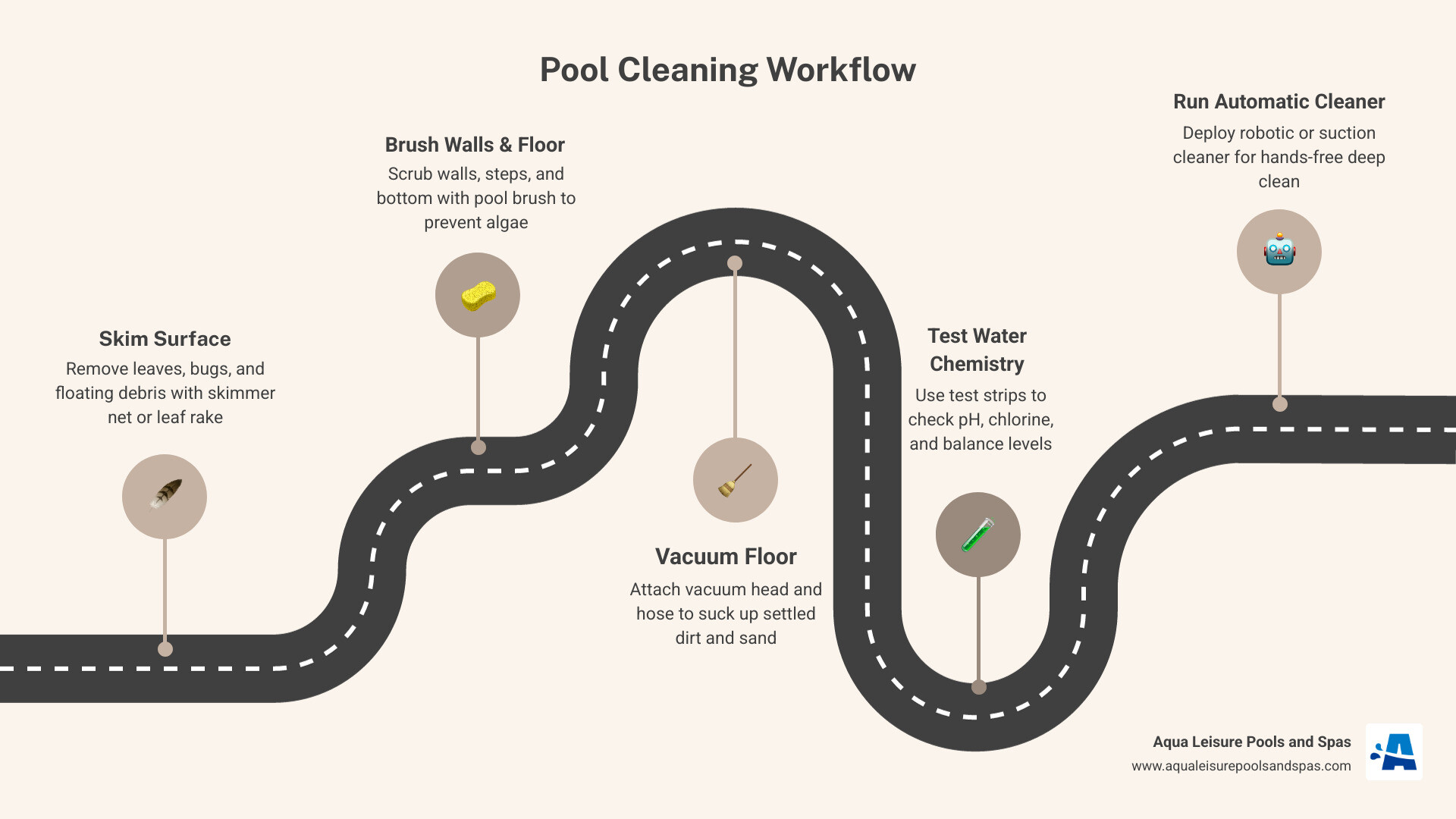
- Skimmer net: A flat, shallow net used to scoop leaves, bugs, and floating debris before it sinks. Daily skimming saves a lot of later vacuuming.
- Leaf rake: Similar idea, but with a deeper bag that handles heavier debris loads. It is the better choice after storms or in leafy yards.
- Pool brush: Used on walls, floors, steps, and corners to loosen dirt and prevent algae. Nylon brushes are generally better for vinyl and fiberglass, while stiffer options are better suited to harder surfaces.
- Vacuum head: Connects to a telescopic pole and vacuum hose, then glides across the pool floor to remove settled dirt. Weighted heads stay in contact with the surface better, and flexible heads follow contours more easily.
- Telescopic pole: The do-everything handle. It extends to reach the center of the pool and connects to nets, brushes, and vacuum heads.
- Vacuum hose: Links the vacuum head to the skimmer or suction port. Size and length matter. A hose should be long enough to reach the farthest point without turning your pool deck into a wrestling match.
Real-world product trends back this up. Manual basics still get huge review counts in 2026, including a heavy-duty leaf rake with more than 31,000 reviews and a 4.2-star rating, a skimmer net with more than 10,000 reviews and a 4.5-star rating, and a popular manual vacuum head with more than 12,000 reviews and a 4.3-star rating. In other words, the old-school tools still earn their spot.
Automatic pool cleaning tools: pros, cons, and who they fit best
Automatic cleaners come in three main types: suction-side, pressure-side, and robotic. For a deeper dive, visit Automatic Swimming Pool Cleaner Guide Let The Robots Do The Work and The Ultimate Guide To Choosing The Right Automatic Pool Cleaner Hose.
- Suction cleaners connect to the pool’s suction system and pull debris into the filtration system. They are usually easier to install and can connect in minutes, but they add filter load.
- Pressure cleaners use pressure from the return side to move and collect debris. Some models require a booster pump. They are often good for larger debris.
- Robotic cleaners run independently from the pool system. Many handle floors, walls, and waterlines, and some use smart mapping or app controls. They usually offer the most convenience and the least strain on the pool’s filter system.
Benefits of automatic cleaners:
- Save time every week
- Reduce manual vacuuming
- Improve routine coverage
- Help on larger pools or oddly shaped pools
Drawbacks:
- Higher upfront cost
- More parts, batteries, cords, or hoses to manage
- Some models are surface-specific or pool-type-specific
- Pressure models may require additional equipment
A few product examples show the range. The PoolVac XL Suction Cleaner-Concrete Pools (Open Line) is a suction cleaner designed for concrete inground pools and connects quickly without a booster pump. On the robotic side, solar-powered automatic skimmers have also grown in popularity, with one widely reviewed model earning more than 5,600 reviews and a 4.6-star rating.
Best pool cleaning tools for above-ground vs. inground pools
Above-ground and inground pools do not always use the same gear.
For above-ground pools:
- Choose softer brushes for vinyl liners
- Use lighter vacuum heads that will not gouge or drag
- Check hose compatibility carefully, since above-ground setups often use smaller hose sizes
- Compact maintenance kits are often a smart starting point
For inground pools:
- Heavier weighted vacuum heads can improve contact with the floor
- Concrete or plaster pools may benefit from wheeled vacuum heads and stronger brushes
- Automatic cleaners are often more practical on larger pool footprints
- Deep ends and waterlines make wall-climbing capability more useful
Fiberglass pools usually fall somewhere in the middle. They need non-abrasive tools, but they also benefit from regular brushing to reduce film buildup.
Pool shape matters too. A simple oval above-ground pool can often be maintained with a basic kit, while a freeform inground pool with steps, benches, and a deep end may need a mix of manual tools and an automatic cleaner. For broader maintenance guidance, see Everything You Need To Know To Keep Your Pool Clean.
How to Choose, Compare, and Build a Complete Cleaning Kit
A smart cleaning kit should match the pool surface, debris level, and the amount of time an owner actually wants to spend cleaning. Not everyone dreams of spending Saturday morning chasing leaves in flip-flops.
How to choose pool cleaning tools for your pool type, size, and budget
Start with five questions:
What type of pool is it? Vinyl, fiberglass, concrete, and plaster surfaces need different brush and vacuum head styles.
How big is the pool? Larger pools benefit more from automatic cleaners and longer poles or hoses.
What kind of debris shows up most? Leaves, pine needles, sand, bugs, and acorns all behave differently. Heavy tree debris calls for a leaf rake and possibly a stronger vacuum solution.
How often will it be cleaned? A daily skimmer and weekly brushing routine can keep a simple kit effective. If maintenance gets skipped often, automation becomes more attractive.
How much storage space is available? Long poles, hoses, and robotic units all need dry, organized storage.
A good entry-level kit includes a telescopic pole, skimmer net, brush, vacuum head, hose, and test strips. Mid-range setups may add a better vacuum head, a leaf rake, and replacement accessories. Premium setups often include a robotic or suction cleaner plus manual tools for touch-ups.
Top-rated pool cleaning tools and price ranges in 2026
In 2026, buyers are clearly paying attention to review count, star rating, and whether a tool solves a specific problem well.
Some of the strongest-reviewed product categories in the research include:
- Pool test strips with more than 42,000 reviews and a 4.4-star rating
- Manual skimmer nets with more than 10,000 reviews and a 4.5-star rating
- Flexible vacuum heads with more than 6,000 reviews and a 4.5-star rating
- Maintenance kits with more than 6,800 reviews and a 4.4-star rating
- Cordless handheld vacuums with more than 11,000 ratings and a 4.0-star rating
Two notable examples are the POOL BLASTER Max Cordless Pool Vacuum for Deep Cleaning & Strong Suction, Handheld Rechargeable Swimming Pool Cleaner for Inground and Above Ground Pools, Hoseless Pool Vac by Water Tech : Swimming Pool Handheld Vacuums : Patio, Lawn & Garden and the Swimline HydroTools 8165 Swimming Pool Flexible Weighted Vacuum Head w – VMInnovations.
The cordless vacuum stands out for portability and weekly spot cleaning, especially on steps, corners, and smaller debris zones. The flexible weighted vacuum head stands out for manual floor cleaning and better surface contact.
Broadly speaking:
- Manual tools are usually the most budget-friendly
- Maintenance kits offer value for new pool owners
- Cordless handheld vacuums sit in the middle
- Full automatic and robotic systems are usually the premium end
Test strips, accessories, and the basic kit most owners actually need
Cleaning the pool without checking chemistry is like mopping a floor while the sink is still overflowing. Water balance matters.
A complete basic kit should include:
- Telescopic pole
- Skimmer net
- Leaf rake
- Pool brush matched to surface
- Vacuum head
- Vacuum hose
- Test strips
- Replacement filter or debris bags if using an automatic cleaner
- Hose cuffs or adapters if needed
- A simple storage area out of sun and weather
Test strips are especially useful because they make routine checks quick. One 7-in-1 strip product in the research had more than 42,000 reviews, showing how common and useful these are for everyday pool care.
Accessories matter more than many owners expect:
- Pole locking mechanisms should hold tight without slipping
- Vacuum hose cuffs should fit securely
- Fine mesh nets catch smaller debris
- Filter care supplies help protect circulation and water clarity
Helpful reading:
Smart Pool Cleaning Habits for Faster, Safer Maintenance
The best pool cleaning tools work even better when paired with a routine. Aqua Leisure Pools and Spas helps pool owners across Doylestown, Dickson City, Wilkes-Barre, Bartonsville, and surrounding Pennsylvania communities build a maintenance plan that fits real life, not fantasy life.
Safety, storage, and maintenance tips to make pool cleaning tools last longer
A few habits make tools last much longer:
- Rinse tools after use to remove chlorine residue and debris
- Store poles, brushes, and nets out of direct UV exposure
- Hang hoses loosely to reduce kinks and tangles
- Clean filter bags and canisters regularly
- Recharge cordless units as directed and store batteries in moderate temperatures
- Keep decks dry while cleaning to reduce slip hazards
- Be cautious with electrical equipment near water
- Never mix pool chemicals or handle them carelessly during maintenance
Brushing once a week is a widely recommended best practice because it helps prevent algae and improves chemical distribution. Regular skimming also keeps debris from sinking and turning a quick cleanup into a mini expedition.
For more on safer maintenance, visit Safety Tips When Cleaning Your Pool.
When to upgrade from manual tools to an automatic cleaner
Manual tools are enough for many pools, but some signs point to an upgrade:
- The pool is large and takes too long to vacuum by hand
- There is frequent leaf or debris buildup
- The owner struggles to keep up with weekly cleaning
- The pool has lots of walls, coves, benches, or waterline buildup
- Spot cleaning keeps turning into full-pool cleaning
- The existing cleaner is outdated or unreliable
An automatic cleaner can reduce labor, improve consistency, and make ownership more enjoyable. That does not mean manual tools disappear. Even with the fanciest cleaner, owners still need a pole, net, brush, and test strips. Robots are impressive, but they still cannot put away the patio furniture.
For more guidance, see Automatic Swimming Pool Cleaner Guide Let The Robots Do The Work 2.
If a homeowner wants help choosing the right setup for an above-ground pool, an inground pool, a spa, or a full backyard upgrade, Aqua Leisure Pools and Spas offers support as a one-stop shop for pool and spa sales, installation, and maintenance throughout Northeastern Pennsylvania. Helpful next steps:
Posted by chris@enx2marketing.com in Pools