


Glow Up Your Summer Nights Using Above Ground Pool Strip Lights

Install Above Ground Pool Strip Lights Without Damaging Your Pool
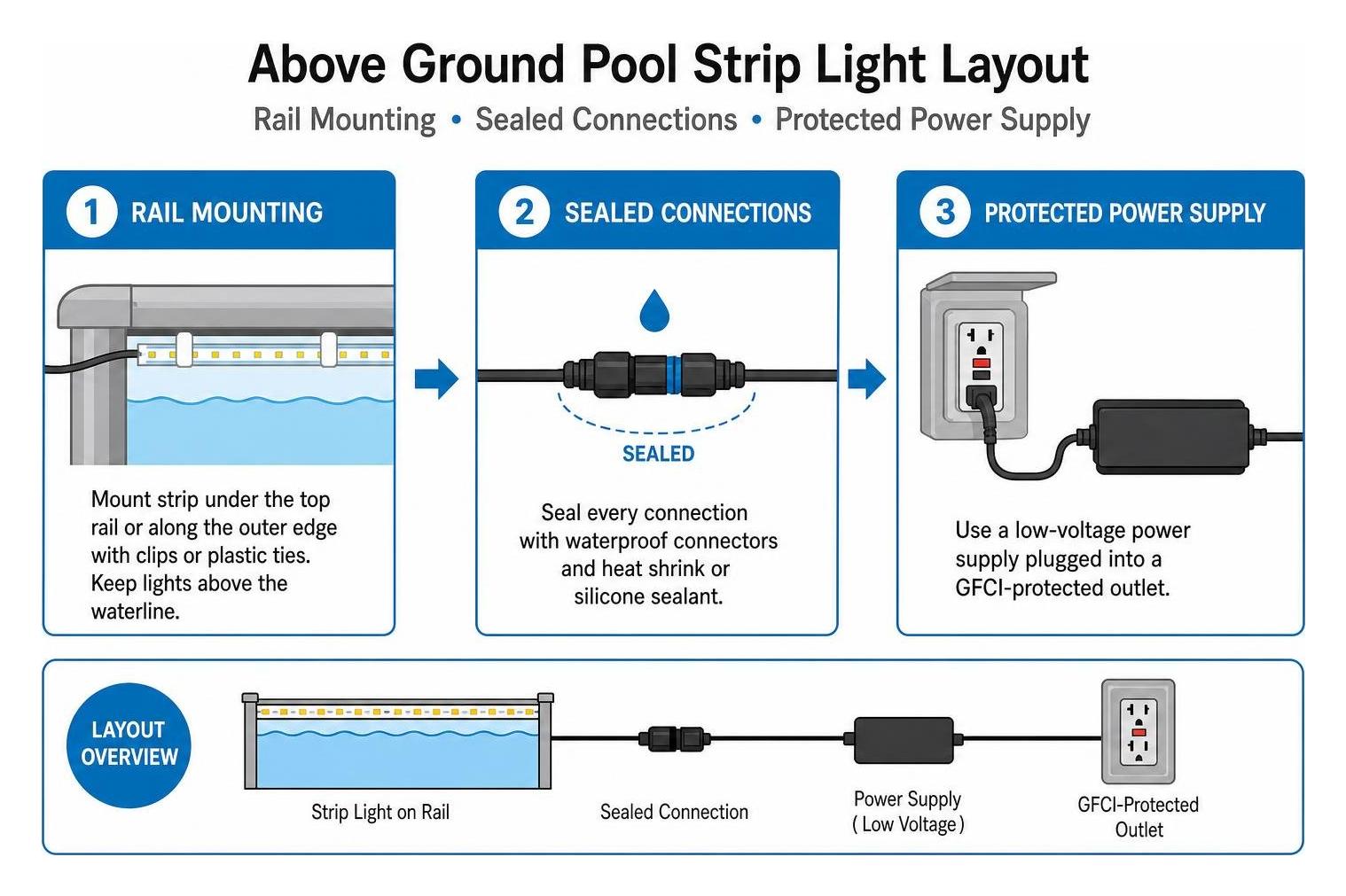
To install above ground pool strip lights, measure your pool’s perimeter, then choose a low-voltage strip made for pool use. Mount it under the top rail or along the outer edge with removable clips or plastic ties. Keep the lights above the waterline, seal every connection, and use a GFCI-protected power source. Before you buy or wire anything, check the product’s pool-use listing and your local electrical rules.
The result is an even glow around the pool without cutting into its wall. Start with a safe layout; you can choose colors and controls once you know where the lights and power supply will go. The U.S. Consumer Product Safety Commission provides pool electrical safety guidance that reinforces the importance of GFCI protection and listed equipment around water.
Relevant articles related to above ground pool strip lights:
- above ground pool light installation
- above ground pool wall light
- adding lights to above ground pool
Why Choose Above Ground Pool Strip Lights for Your Backyard Oasis

Traditional pool illumination often relies on a single high-wattage bulb mounted into the side wall. While this setup works for basic visibility, it frequently casts harsh shadows and leaves dark spots across large sections of the water. Linear LED strips distribute illumination evenly along the entire perimeter, transforming the water into an inviting, uniformly glowing oasis.
Modern strip lighting operates via electroluminescence, converting electrical energy directly into photons. Incandescent bulbs lose roughly 90 percent of their input energy as infrared heat, while LEDs produce virtually no waste heat and generate 80 to 120 lumens per watt compared to just 12 to 17 lumens per watt from older incandescent designs. For homeowners looking to add lights to your above ground pool, linear strips provide an ideal balance of full-perimeter coverage and low power consumption.
| Feature | Incandescent Bulbs | Traditional LED Fixtures | LED Strip Lights |
|---|---|---|---|
| Energy Consumption | High (300W – 500W) | Low (30W – 60W) | Very Low (4.8W/m) |
| Luminous Efficacy | 12 – 17 lumens/watt | 80 – 120 lumens/watt | 80 – 110 lumens/watt |
| Light Distribution | Single-point beam; harsh shadows | Single or dual point source | Continuous, uniform perimeter glow |
| Typical Lifespan | 2,000 – 5,000 hours | 30,000 – 50,000 hours | 25,000 – 50,000 hours |
| Installation Impact | Requires through-wall niche cut | Requires mounting bracket or niche | Non-invasive under-rail clips or ties |
Choosing the Best Above Ground Pool Strip Lights: IP Ratings and Specs
Choosing durable strip lighting requires understanding ingress protection (IP) ratings and materials. The two most common ratings encountered for outdoor pool lighting are IP67 and IP68:
- IP67 Rating: Dust-tight and protected against temporary water submersion up to 1 meter for 30 minutes. This rating is suitable for strips mounted high under the top coping or outer edge where they encounter splashing and rain.
- IP68 Rating: Dust-tight and designed for continuous submersion in water under specified depths. This rating is required if strips are positioned close to or below the constant waterline.
Safety is paramount around water, which is why pool strips operate on safe low-voltage direct current systems (12V DC or 24V DC). Linear strip systems produce between 200 and 400 lumens per linear foot, providing crisp accent visibility without blinding glare. For long-term durability, select strips encased in high-grade, UV-stable silicone or polyurethane rather than cheap PVC that turns brittle under sun exposure. Quality silicone casings resist degrading from chlorine, bromine, and saltwater sanitizers. When planning your pool aesthetic, comparing colored pool lighting options helps determine whether standard warm white, dynamic RGB, or multi-channel RGBW strips best complement your backyard landscape.
Key Benefits: Energy Efficiency, Smart Controls, and Aesthetics
Modern LED strips consume as little as 4.8 watts per meter while delivering up to 210 lumens per meter of brightness. With an operating lifespan reaching 25,000 to 50,000 hours, they eliminate the hassle of frequent bulb replacements.
Today’s lighting setups also offer sophisticated control capabilities. Modern controllers integrate radio frequency (RF) remotes, Bluetooth pairing, and Wi-Fi smart systems compatible with Amazon Alexa or Google Home. Many systems include sound-responsive modes that synchronize light pulses and color shifts to backyard music playlists, turning evening swims into dynamic entertainment. Homeowners consulting our complete guide to swimming pool lighting will find that modern automation makes scheduling sunset timers and custom color scenes effortless.
Step-by-Step Installation and Safety Protocols
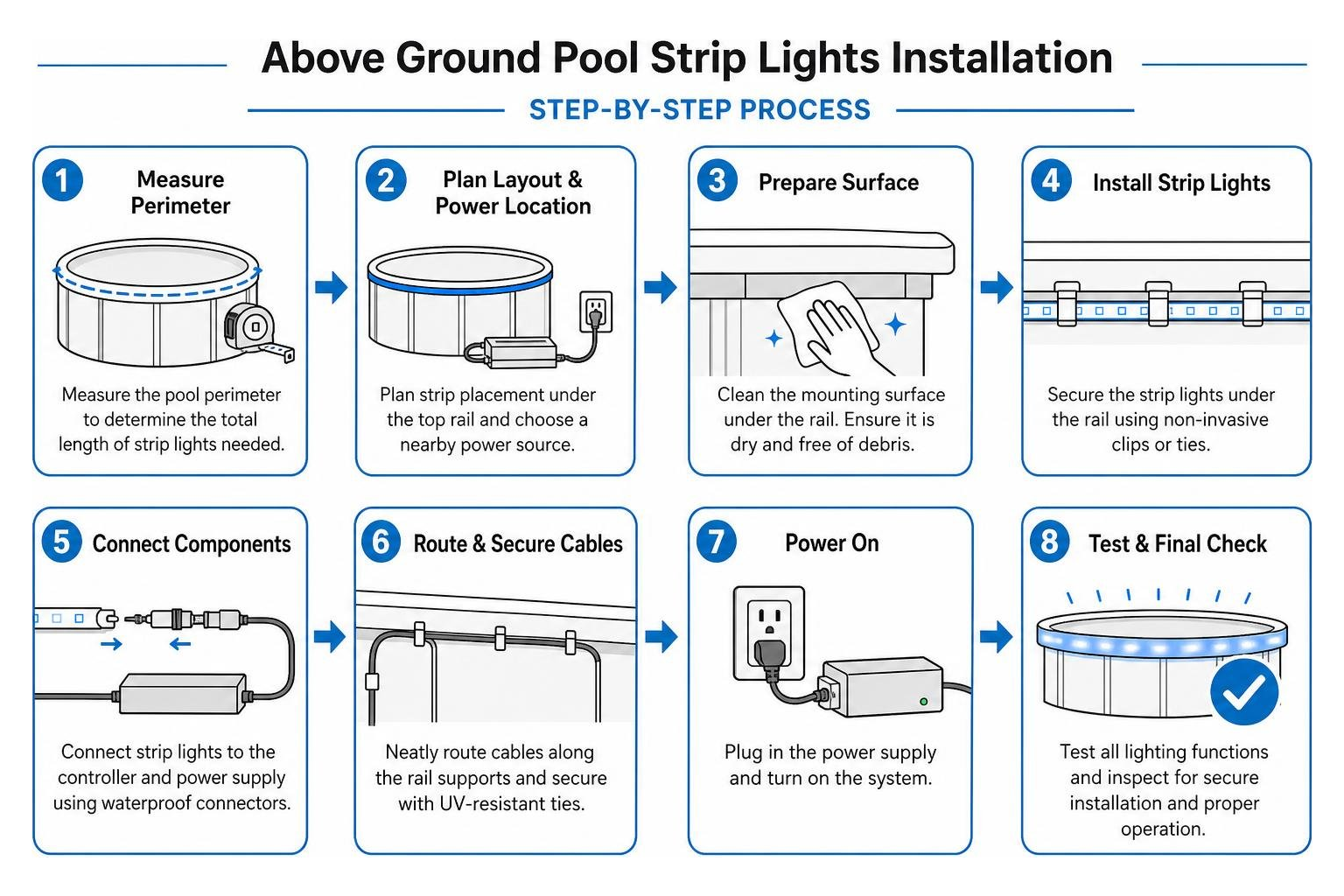
Installing strip lights on an above ground pool requires careful planning to protect the pool structure and ensure electrical safety. Adhering to safe pool lights installation standards ensures a smooth project from initial layout to final illumination.
How to Install Above Ground Pool Strip Lights Safely
Proper installation keeps your lighting secure without causing structural damage:
- Measure the Perimeter: Calculate the exact circumference or perimeter of your pool. For instance, a standard 21-foot round pool has a circumference of roughly 66 feet, requiring multiple strip sections or a single continuous long run.
- Clean and Degrease: Thoroughly clean the underside of the top rail with isopropyl alcohol to remove dirt, grease, and moisture before applying any adhesive backing.
- Use Non-Invasive Fasteners: Never drill screws directly into the top rail or pool wall, as punctures promote rust and risk puncturing the vinyl liner. Secure the strip using outdoor-rated, UV-resistant plastic mounting clips or heavy-duty zip ties fastened around the rail brackets.
- Seal Cut Segments: If you must cut the strip to length, cut only along the manufacturer-designated cut marks. Coat the exposed end in marine-grade silicone adhesive and slide a silicone end cap over the cut, allowing it to cure for 24 hours.
- Manage Cord Slack: Leave several inches of cord slack near connection points to prevent mechanical tension as pool materials expand and contract with temperature shifts. Run all lead wires through weather-resistant conduit toward the transformer housing. For more detailed instructions on non-invasive setups, review our step-by-step above ground pool light installation guide.
Electrical Codes, GFCI Protection, and Low-Voltage Transformers
Electrical safety around swimming pools is governed strictly by the National Electrical Code (NEC Article 680). Water and electricity require rigorous protective measures:
- GFCI Protection: The 120V primary electrical supply feeding your pool lighting transformer must be protected by a dedicated Ground Fault Circuit Interrupter (GFCI).
- Class 2 Power Supply: Use an isolated Class 2 low-voltage transformer (12V or 24V DC). The transformer steps dangerous line voltage down to safe operating levels while isolating the secondary DC output.
- Weatherproof Enclosures: House all primary controllers, splitters, and non-submersible connections inside a listed, weatherproof NEMA junction box positioned well above flood levels and at least 5 to 10 feet away from the water’s edge.
- Listed Equipment: Always use lighting components listed and certified for outdoor wet locations. When evaluating traditional fixtures alongside linear accents, our guide to above ground through-wall pool lights outlines code-compliant electrical boundaries in detail.
Routine Maintenance, Chemical Resistance, and Winterization
Even durable outdoor LED strips benefit from routine care to maximize operational life:
- Maintain Balanced Water Chemistry: High sanitizer levels or unbalanced pH (outside the 7.2 to 7.8 range) accelerate silicone yellowing and weaken mounting adhesives. Keep chlorine and alkalinity within recommended ranges to safeguard light casings.
- Inspect Housings Seasonally: Check the strip periodically for signs of moisture ingress, cracked end caps, or mineral scale buildup. Wipe down outer casings with a soft microfiber cloth and clean water.
- Winterization in Cold Climates: In regions like Pennsylvania where winter temperatures drop below freezing, remove detachable clip-mounted strips during autumn pool closing. Freezing ice sheets pushing against pool rails can tear adhesives and pinch silicone casings. Clean, dry, and store your lighting kit indoors until spring.
Whether you are enhancing an existing backyard setup or exploring premium above ground pools for a new installation, Aqua Leisure Pools and Spas provides expert guidance and installation support across Northeastern Pennsylvania, including Doylestown, Dickson City, Wilkes-Barre, Bartonsville, Scranton, and Allentown. Contact our team today to build your ideal backyard retreat.
Posted by Aqua Leisure Pools & Spas in Pools