


In-Depth Guide to Swimming Pool Covers
Why Swimming Pool Covers Are One of the Smartest Investments You Can Make for Your Pool
Swimming pool covers are protective barriers placed over your pool to reduce heat loss, block debris, cut chemical use, save water, and improve safety — all at once.
Here’s a quick look at the main types and what they do:
| Cover Type | Main Purpose | Best For |
|---|---|---|
| Solar cover | Heat retention, evaporation control | Year-round energy savings |
| Winter cover | Off-season protection | Closing the pool for winter |
| Safety cover (mesh or solid) | Child and pet protection, debris blocking | Families, safety compliance |
| Leaf net cover | Debris collection | Heavy leaf fall seasons |
| Automatic cover | Convenience, daily use | Easy open/close every day |
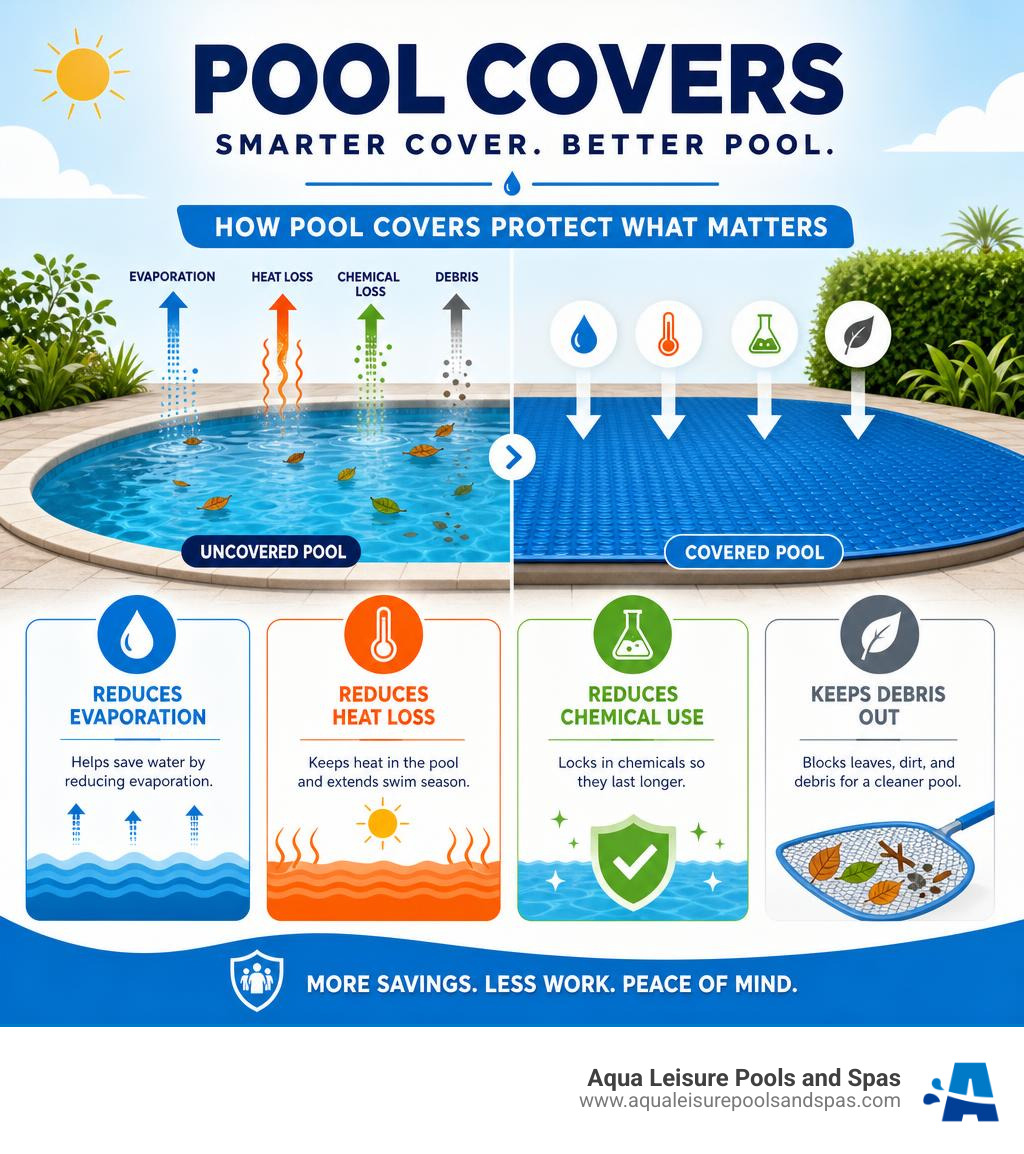
Your pool loses heat, water, and chemicals constantly — even when no one is swimming. Most of that loss happens through the surface. Evaporation alone accounts for the largest share of energy loss in any outdoor pool. Research from the U.S. Department of Energy shows that simply covering your pool when it’s not in use can cut heating costs by 50% to 70%.
On top of energy savings, a good cover can:
- Reduce water loss by 30% to 50%
- Cut chemical consumption by 35% to 60%
- Keep leaves, dirt, and debris out of the water
- Add a critical layer of safety for children and pets
Whether you’re looking to extend your swim season, protect your pool through winter, reduce your monthly bills, or simply keep the water cleaner between uses — there’s a pool cover built for that job.
This guide breaks down every major cover type, how to size and install one correctly, which accessories actually help, and how to buy with confidence.
Swimming pool covers terminology:
Types of Swimming Pool Covers and How They Perform
Not all pool covers do the same job. Some are made for summer heat retention. Others are built to survive Northeastern Pennsylvania winters, falling leaves, freeze-thaw cycles, and the occasional “where did all these twigs come from?” moment.
| Cover Type | Main Strength | Best Season | Key Tradeoff |
|---|---|---|---|
| Solar cover | Warms water and slows evaporation | Spring, summer, early fall | Not a safety cover |
| Winter cover | Blocks debris during closing season | Fall and winter | Needs secure tie-downs and water management |
| Safety cover | Helps prevent accidental pool access | Year-round or off-season | Requires correct fit and hardware |
| Leaf net | Catches leaves before they sink | Fall | Usually used with another cover |
| Mesh cover | Allows rain and melted snow to drain | Winter | Fine sediment and sunlight may pass through |
| Solid cover | Blocks sunlight and debris | Winter | Needs a pump or drain panel |
| Automatic cover | Fast daily open-and-close use | Swim season | Requires professional setup and maintenance |
For a broader overview, Aqua Leisure Pools and Spas explains the main categories in The Different Types of Pool Covers.
Solar Swimming Pool Covers for Heat Retention and Evaporation Control

Solar covers, often called bubble blankets, are lightweight covers made from UV-stabilized polyethylene. The bubbles face down into the water, where they help transfer solar warmth into the pool and reduce heat loss overnight.
Common thickness options include:
- 8 mil: lighter and easier to handle
- 12 mil: a balanced choice for durability and manageability
- 16 mil: heavier, stronger, and often better for heat retention
Solar covers are popular because they attack one of the biggest pool problems: evaporation. Some solar cover product specifications list evaporation reduction up to 95% under ideal use conditions. The U.S. Department of Energy also notes that pool covers can reduce water use and chemical demand because less water escapes into the air.
A solar cover can also be trimmed to fit around steps, ladders, and unusual corners. This is useful for both inground and above-ground pools. For a deeper look at durability, Aqua Leisure offers a helpful solar cover durability guide and a dedicated guide to inground pool solar covers.
Solar alternatives include liquid solar blankets, sun rings, and heat squares. They can help in some situations, but they are not exact replacements for a full cover.
Solar cover vs. alternatives:
- Solar cover: Best overall heat retention and evaporation control, but needs storage and handling.
- Liquid solar blanket: Easy to use, but wind, swimmers, and water movement can reduce performance.
- Sun rings: Simple and modular, but they do not cover the full pool surface.
- Heat squares: Easier to move than one large blanket, but gaps reduce efficiency.
A reel is strongly recommended for larger covers. Without one, removing a solar blanket can feel like wrestling a wet blue burrito.
Examples of typical retail solar cover specifications include 12 mil and 16 mil rectangular covers for above-ground and inground pools, such as this 16 mil solar cover example and this 12 mil solar cover example.
Winter, Safety, and Leaf Net Covers for Off-Season Protection
Winter covers protect the pool when swimming season ends. In Pennsylvania, that means blocking leaves, branches, dirt, snow, and winter runoff. A properly installed winter cover can make spring opening much easier because less debris reaches the water.
There are several off-season options:
- Standard winter covers: Usually solid tarp-style covers held with water bags, cable systems, or clips.
- Mesh safety covers: Allow rain and melted snow to drain through while blocking larger debris.
- Solid safety covers: Block sunlight and debris more completely, helping reduce algae growth.
- Leaf net covers: Sit above another cover or over the pool during leaf season for quick debris removal.
Safety covers deserve special attention. A true safety cover is not just a tarp. Look for covers that meet ASTM F1346, the standard commonly used for safety pool covers. Important features include reinforced webbing, strong stitching, abrasion-resistant materials, stainless steel springs, brass anchors, and a secure overlap.
Mesh safety covers drain naturally, so they usually require less standing-water management. Solid covers can keep water cleaner and darker, which helps limit algae growth, but they need a cover pump or built-in drain panel to remove rain and melted snow.
For storm-heavy seasons, Aqua Leisure’s guide on how to protect a pool during stormy weather is a useful companion to cover planning.
How to Choose, Size, Install, and Buy Swimming Pool Covers
Choosing a cover starts with the pool, but it should end with the homeowner’s real goal.
Consider:
- Pool type: Above-ground, inground, semi-inground, or spa
- Shape: Round, oval, rectangle, kidney, Roman end, or freeform
- Climate: Snow, wind, leaves, and freeze-thaw conditions
- Main benefit: Heat retention, safety, debris blocking, or winterization
- Handling: Manual, reel-assisted, or automatic
- Maintenance: Pumping, cleaning, storage, and inspection
- Warranty: Material coverage, seam coverage, and exclusions
- Support: Local help, installation guidance, and return policies
Aqua Leisure Pools and Spas serves homeowners in Doylestown, Dickson City, Wilkes-Barre, Bartonsville, Scranton, Lake Wallenpaupack, Tannersville, Bloomsburg, Allentown, and surrounding Pennsylvania communities. Their team sells, installs, and maintains pools and spas, making them a local resource for choosing the right cover instead of guessing from a product photo online.
For supplies and expert help, visit the pool supplies page or explore Aqua Leisure’s pool showrooms.
Above-Ground vs Inground Swimming Pool Covers: Design, Installation, and Maintenance
Above-ground pool covers and inground pool covers differ mainly in how they attach.
Above-ground pool covers often use:
- Cable and winch systems
- Wall clips
- Winter cover clips
- Air pillows under winter covers
- Round or oval sizing
Air pillows help lift the center of the cover, encouraging water and ice to move outward instead of sitting heavily in the middle. Cable systems help hold the cover around the pool wall.
Inground pool covers often use:
- Deck anchors
- Springs and straps
- Water bags or water tubes for standard winter covers
- Custom measurements for steps, ladders, coping, and raised features
- Cover pumps for solid covers
Custom inground covers are often needed for freeform pools, attached spas, waterfalls, unusual stairs, or raised walls. Stock covers can work well for simple rectangles, but fit matters. A poor fit can create gaps, stress points, and safety concerns.
For pool planning, Aqua Leisure has resources for both above-ground pools and in-ground pools. Smaller round pool owners can also review this 13 ft round pool cover guide.
Sizing and Fit: Measuring Your Pool Correctly Before You Buy
Correct sizing is where many cover problems begin. A cover that is too small will not protect properly. A cover that is much too large can sag, shift, or become difficult to secure.
Measure carefully:
- Rectangle pools: Measure inside edge to inside edge for length and width.
- Round pools: Measure diameter across the center.
- Oval pools: Measure the longest length and widest width.
- Kidney or freeform pools: Use a detailed measuring form with multiple reference points.
- Pools with steps: Note step location, width, and projection.
- Obstructions: Mark ladders, diving boards, handrails, waterfalls, raised walls, and spa spillovers.
Pool size and cover size are not always the same. Many winter and safety covers include overlap beyond the pool edge. Product specifications may describe both the pool size and the actual cover size, so read carefully before buying.
Solar covers are more forgiving because many can be trimmed with scissors. Safety covers are not. For safety covers, correct measuring and professional installation are strongly recommended.
For small-pool planning, see Aqua Leisure’s 10 ft swimming pool with cover checklist.
Accessories That Make Swimming Pool Covers Easier to Use and Maintain
The right accessories can turn a cover from “great idea, annoying chore” into something the pool owner actually uses.
Helpful accessories include:
- Solar reels: Make solar covers easier to remove and store.
- Reel straps: Attach the cover securely to the reel tube.
- Cover pumps: Remove standing water from solid winter or safety covers.
- Water bags and water tubes: Hold inground winter covers in place.
- Winter clips: Help secure above-ground covers against wind.
- Cable kits and winches: Tighten above-ground winter covers.
- Air pillows: Reduce ice pressure on above-ground pools.
- Leaf rakes: Clear debris before it breaks down in water.
- Storage bags: Protect covers when not in use.
- Anchor tools: Help install and remove safety cover springs.
- Patch kits: Repair small tears before they grow.
Maintenance is simple but important. Remove leaves regularly, pump off standing water when needed, wash covers with mild soap, let them dry before storage, and inspect seams, straps, anchors, and grommets each season.
For more savings-focused tips, read Aqua Leisure’s guides on reducing evaporation and saving water and reducing pool water waste.
Final Buying Checklist for Long-Term Value and Backyard Safety
Before buying a pool cover in 2026, homeowners should check more than the size label. Demand is high, with large online marketplaces showing tens of thousands of pool cover listings, but more choices do not always mean better choices.
Use this final checklist:
- Confirm the cover matches the pool type: above-ground, inground, or spa.
- Choose the right purpose: solar, winter, safety, leaf, mesh, solid, or automatic.
- Check material quality, UV resistance, and seam reinforcement.
- For safety covers, verify ASTM F1346 compliance.
- Review drainage needs: mesh drainage, drain panels, or cover pump.
- Make sure the cover fits steps, ladders, rails, and custom features.
- Look for clear warranty terms.
- Consider ease of handling and whether a reel is needed.
- Ask about installation support.
- Buy from a source with knowledgeable service and reasonable return policies.
- Plan seasonal maintenance before the first storm or leaf drop.
Aqua Leisure Pools and Spas helps Pennsylvania homeowners choose covers that fit their pools, climate, safety needs, and backyard goals. Whether the project is a new pool, a replacement cover, or a full dream backyard upgrade, their team can help match the right product to the way the pool is actually used.
For seasonal planning, visit Aqua Leisure’s guide: Is Your Pool Prepared for the Weather?
Posted by Aqua Leisure Pools & Spas in Pools