


Shallow End Pool Rope: Where the Fun Meets the Floor

Understanding Shallow End Ropes and Pool Safety Boundaries
A shallow end rope is a floating boundary line installed across swimming pools to visually separate shallow water areas from deeper zones, helping swimmers—especially children—stay in safe depths appropriate for their skill level.
Key Functions of Shallow End Ropes:
- Define safe swimming zones by marking where shallow water transitions to deeper areas
- Prevent accidents by providing a clear visual and physical barrier
- Support recreational features like rope swings when installed with proper depth requirements
- Meet safety standards required by pool regulations and local codes
If you’re planning a backyard pool or looking to upgrade your existing setup, understanding the role of shallow end ropes is essential for creating a safe family environment. These simple yet critical safety features come in two main forms: boundary float lines that mark depth transitions, and rope swings designed for recreation in properly configured pools.
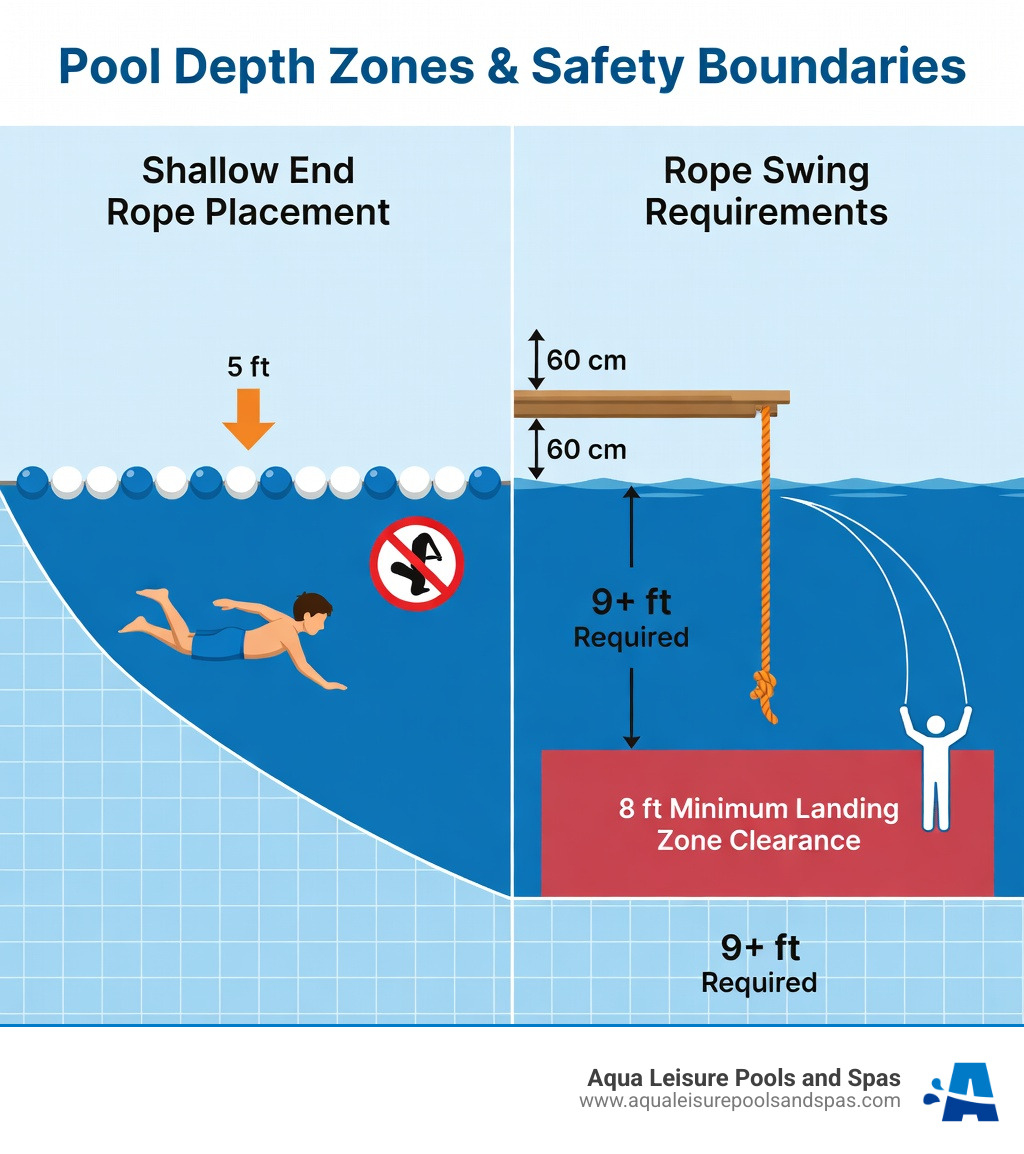
The difference matters more than you might think. According to research from the Lifesaving Society, rope swings require minimum water depths of 2.75 meters (9 feet) where the launch point is 60 cm or less above water—significantly deeper than typical shallow ends. That’s because pendulum mechanics create forces that push swimmers into deeper trajectories than a simple jump would.
Whether you’re installing a new pool or enhancing safety at your existing one, the right rope system helps transform your backyard into a worry-free oasis where fun and safety coexist.
Essential Safety Standards for Your Shallow End Rope
When most people think of a shallow end rope, they picture the classic blue and white floats bobbing on the surface. While these are the most common, the term can also apply to recreational rope swings used in deeper sections of the pool. Understanding the safety standards for each is the first step toward a secure swimming environment.
A standard safety float line serves as a visual and physical reminder of the floor’s slope. In Pennsylvania, where backyard pools are a staple of summer life in places like Wilkes-Barre and Doylestown, these ropes are often required by local codes to mark the point where the floor begins to drop off toward the deep end.
Comparing Safety Ropes and Recreational Swings
It is vital to distinguish between a rope meant to keep people out of deep water and a rope meant to swing people into it. The engineering and depth requirements differ wildly.
| Feature | Standard Safety Float Line | Recreational Rope Swing |
|---|---|---|
| Primary Purpose | Define boundaries and prevent accidental entry to deep water. | Supervised recreation and controlled water entry. |
| Required Depth | Usually installed at the 4.5 to 5-foot depth transition. | Minimum 2.75m (9 ft) to 3m (9.8 ft) depending on launch. |
| Installation | Anchor bolts in the pool wall. | Overhead fulcrum mounted 3–5m inside the pool edge. |
| Supervision | General adult or lifeguard supervision. | Constant, dedicated lifeguard supervision. |
To ensure your pool is as safe as possible, you should familiarize yourself with 9 safety standards your pool should meet. This includes having the right Pool safety equipment on hand, such as reaching poles, life rings, and, of course, a properly tensioned shallow end rope.
Boundary Definition and Buoy Lines
The buoy line isn’t just for show. It provides a tactile warning for swimmers who may be swimming with their eyes closed or children who aren’t yet tall enough to touch the bottom in the “big kid” section. These ropes should be made of UV-resistant materials like polypropylene, which resists rotting and maintains its strength despite constant exposure to chlorine and Pennsylvania’s summer sun.
The anchor bolts that hold the rope in place must be securely recessed into the pool wall. Loose anchors can lead to a sagging rope, which fails to provide a clear boundary and can even become a tripping or entanglement hazard for those trying to cross it.
Minimum Depth and Landing Zones for a Shallow End Rope Swing
If your definition of a shallow end rope involves a pendulum swing for the kids to launch themselves into the water, safety becomes much more technical. While we call it a “shallow end” feature in some recreational contexts, the water it drops you into is anything but shallow.
According to Scientific research on rope swing safety standards, the depth requirements are non-negotiable. If the launch platform is 60 cm (about 2 feet) or less above the water, the landing area must be at least 2.75 meters (9 feet) deep. If the launch point is between 60 cm and 1 meter, that depth requirement jumps to 3 meters (9.8 feet).
Pendulum Mechanics and Safety
Why such deep water? It comes down to physics. A rope swing operates on pendulum mechanics. When a swimmer swings, they aren’t just falling; they are being accelerated along an arc. This momentum can carry them deeper into the water than a standard vertical jump.
Furthermore, the “landing zone” must be clear of all other activities. This zone should be marked with its own buoy line to prevent other swimmers from wandering into the path of a swinging user. The fulcrum—the point where the rope is attached overhead—should be mounted 3 to 5 meters inside the pool edge to ensure the swimmer clears the deck before they ever let go.
Secondary Attachments
A critical safety feature for any rope swing is a secondary attachment. This is a backup system designed to catch the rope or the user if the primary mounting hardware fails. In a professional setting, this might involve a safety cable or a dual-bolt system. For a home setup, it means ensuring the overhead structure is over-engineered for the weight it will carry.
Installation and Maintenance of Your Shallow End Rope
Proper installation is the difference between a safety feature and a liability. Whether you are in Dickson City or Tannersville, the freeze-thaw cycle of Pennsylvania winters can wreak havoc on pool hardware.
Step-by-Step Installation Basics
When Installing your pool safety rope, follow these guidelines:
- Locate the Transition: Identify the exact point where the shallow floor begins to slope downward.
- Install Recessed Anchors: Use stainless steel or chrome-plated brass anchors that sit flush with the pool wall to prevent scrapes.
- Tension the Rope: The rope should be taut enough to stay in a straight line but have enough “give” to bob with the waves.
- Position the Floats: Space the floats evenly so there are no large gaps where a swimmer could slip through unnoticed.
Inspection and Record Keeping
Pool owners should conduct daily inspections of their shallow end rope. Look for fraying in the fibers, cracks in the plastic floats, or signs of corrosion on the wall anchors.
For recreational ropes, an annual professional inspection is highly recommended. This involves checking the structural integrity of the mounting point and the breaking strength of the rope. It’s a good idea to keep a simple logbook of these checks. If an accident ever occurs, having a record of consistent maintenance shows that you took safety seriously.
Rules and Lifeguard Supervision for Safe Operation
No matter how high-quality your shallow end rope is, it cannot replace human eyes. If you have a pool in Scranton or Bartonsville, you know that summer parties can get rowdy.
Lifeguard Responsibilities
If your pool is large enough to require a lifeguard, or if you are hosting a large event, the lifeguard’s primary responsibility regarding the rope is enforcement. They must ensure that:
- Swimmers do not hang or sit on the safety float line (which can damage the anchors).
- The landing zone for any rope swing remains completely clear.
- Only one person uses the rope at a time.
Essential Rules for Users
Post a clear set of rules near the pool. These should include:
- Swim Test Required: No one should go past the shallow end rope or use a rope swing without passing a basic swim test.
- Foot-First Entry Only: Diving from a rope swing is a leading cause of neck and spinal injuries.
- No Climbing: Users should never attempt to climb the rope to reach the fulcrum.
- Prompt Exit: Once a swimmer enters the water from a swing, they must swim to the side immediately to clear the landing zone for the next person.
For more advice on keeping your guests safe, check out these Pool safety tips.
Beyond the Boundary: Advanced Rope Safety and Materials
When we look closer at the science of ropes, things get interesting. Not all ropes are created equal. In fact, using the wrong type of rope for a pool environment can lead to catastrophic failure.
Scientific research on sharp edges and rope cuts shows that 48% of documented rope breaks in climbing scenarios were caused by cutting against sharp objects. While your pool deck might not be a jagged cliffside, the principle remains: friction and sharp edges are the enemies of rope integrity.
Rope Physics and Breaking Strength
A shallow end rope used for a swing must have a high breaking strength. However, breaking strength isn’t just about how much weight the rope can hold while stationary. It’s about “dynamic load.” When a 150-pound person swings, they can generate forces far exceeding their body weight.
- Shear Forces: These occur when the rope is pulled across a sharp edge, like a poorly finished mounting bracket.
- Frictional Heat: Rapid movement or “rope burn” can actually melt the synthetic fibers of a rope, weakening its core.
- UV Resistance: Pennsylvania summers can be brutal. UV rays break down the molecular bonds in plastic and nylon. Always choose a rope specifically rated for outdoor aquatic use.
Understanding these factors is part of complying with Pennsylvania private pool laws, which emphasize the owner’s responsibility to maintain all safety equipment in working order.
Risks of Improper Use and Shallow End Rope Wear
Even the best equipment wears out. A shallow end rope is constantly attacked by chlorine, which “bleaches” the plastic and makes it brittle over time.
The Danger of Head-First Entry
One of the most significant risks associated with pool ropes—specifically those used for swinging—is the temptation to dive. Entering the water head-first from a height into a pool is extremely dangerous. If the swimmer miscalculates the depth or the arc of the swing, they risk hitting the floor. This is why “Foot-First Entry” must be a strictly enforced rule.
Knot Safety and Load Capacity
Some people try to “fix” a long rope by tying extra knots in it. However, knots can actually reduce the breaking strength of a rope by up to 50% because they create stress points where the fibers are crushed. For a recreational rope, the Lifesaving Society recommends a single knot at the bottom to help with grip, but no more.
If you notice your rope is starting to look “hairy” (fraying) or the floats are faded and cracking, it is time to Learn more about pool safety rope maintenance and consider a replacement.
Alternatives for Recreational and Semi-Inground Pools
Not every backyard has the space for a massive in-ground pool with a 10-foot deep end. If you have a semi-inground pool or a smaller recreational setup, you might need alternatives to the traditional shallow end rope swing.
Float Kits and Adjustable Ropes
For smaller pools, an adjustable float kit is a great solution. These allow you to customize the length of the rope to fit the exact width of your pool. This is especially helpful for L-shaped pools or pools with custom tanning ledges where a standard-length rope wouldn’t fit.
Sloped Terrain Solutions
In Northeastern Pennsylvania, many backyards are sloped. This is where semi-inground pools shine. They can be built into a hill, with one side deeper in the ground than the other. In these cases, the shallow end rope must be carefully placed to account for the unique floor geometry.
If you’re looking for a pool that fits your specific backyard topography, you might want to Explore our in-ground pool options.
Choosing Quality Equipment with Aqua Leisure Pools and Spas
At the end of the day, a shallow end rope is only as good as the team that helps you choose and install it. Aqua Leisure Pools and Spas has been a fixture in the Pennsylvania community for years, serving families from Scranton to Allentown and everywhere in between.
Whether you need a simple boundary marker for your new fiberglass pool in Doylestown or a heavy-duty safety setup for a commercial pool in Wilkes-Barre, we are here to help. Our showrooms in Dickson City and Bartonsville are stocked with high-quality, UV-resistant ropes, recessed anchors, and the expert advice you need to make the right choice.
Creating a backyard oasis is about more than just water and stone; it’s about the peace of mind that comes from knowing your loved ones are safe. Don’t leave your pool safety to chance or a DIY kit from a big-box store. Trust the professionals who understand the local climate and the specific needs of Pennsylvania homeowners.
Ready to secure your pool for the upcoming season? Schedule a consultation at our pool showrooms today and let us help you find the perfect shallow end rope solution for your home. From installation to long-term maintenance, Aqua Leisure Pools and Spas is your partner in backyard fun and safety.
Posted by chris@enx2marketing.com in Swim Safety