


The Ultimate Guide to Dual Zone Swim Spas
Hot Tub or Pool? With Dual Zone Swim Spas, You Don’t Have to Choose
Dual zone swim spas are all-in-one backyard units that combine a swimming area and a hot tub in a single self-contained structure — with each zone maintaining its own independent water temperature.
Here’s a quick overview of what makes them unique:
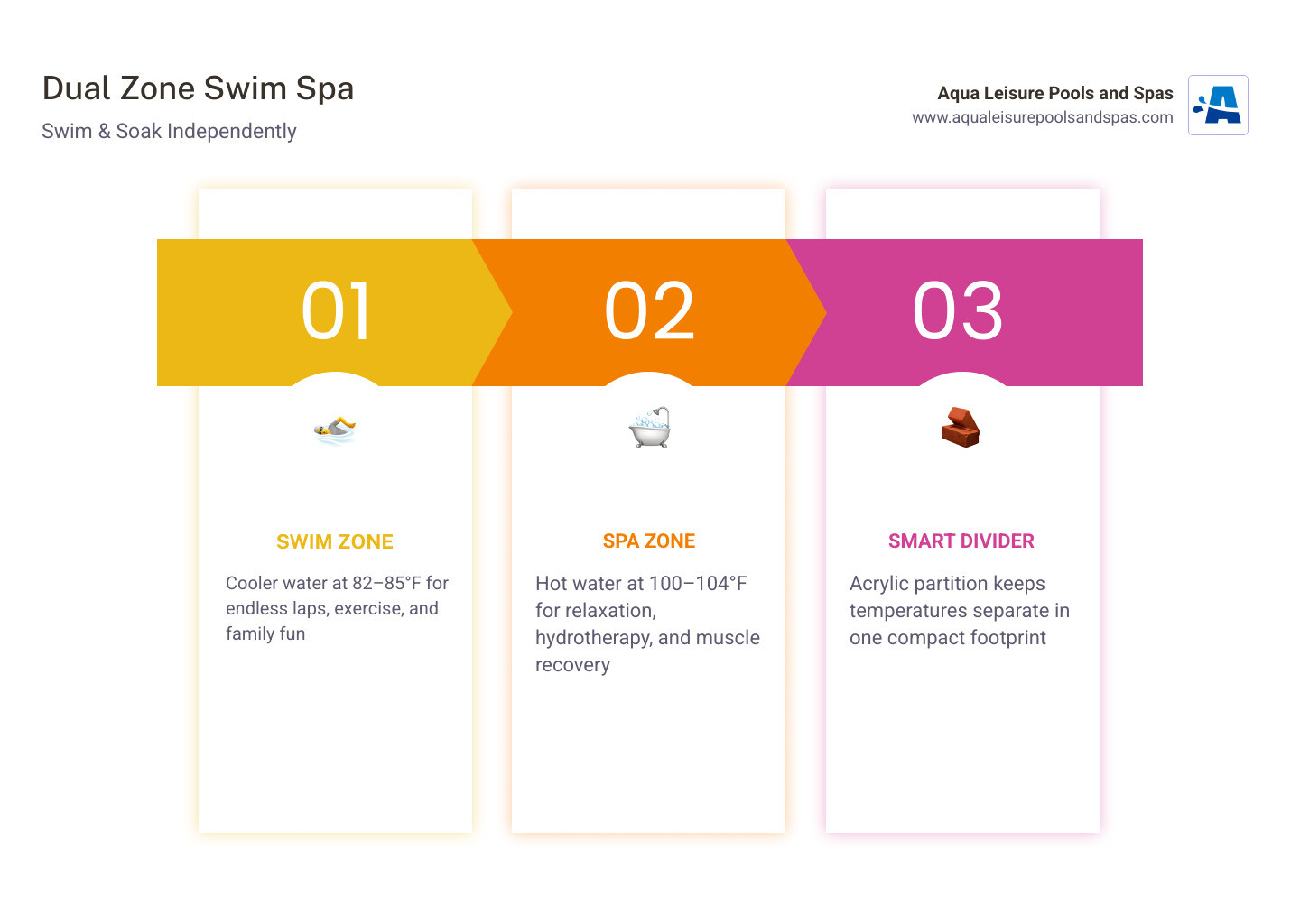
- Two separate zones — a swim lane (typically kept at 82–85°F) and a hot tub area (typically 100–104°F)
- Independent temperature controls — each side has its own heating system and control panel
- Physical divider — an acrylic or built-in partition keeps the two bodies of water separate
- One footprint — most models run 17–21 feet long, far smaller than a pool and hot tub combined
- Year-round use — fully insulated for use in any season or climate
For most homeowners, the choice between a pool and a hot tub feels like a compromise. You either get the exercise and family fun of a pool, or the relaxation and therapy of a spa — but rarely both, especially on a typical suburban lot.
Dual zone swim spas solve that problem entirely.
Whether you want to swim laps before work, let the kids splash around on weekends, or soak tired muscles after a long day, a dual zone swim spa lets every member of the family get what they need — at the same time, at the right temperature.
In this guide, we’ll walk you through everything you need to know: how they work, what they cost, which features matter most, and how to choose the right model for your backyard.
Understanding Dual Zone Swim Spas: Features and Benefits
When you start researching backyard aquatic options, you’ll quickly realize that “swim spa” is a broad term. The “cream of the crop” in this category is undoubtedly the dual zone swim spa. Unlike a single-zone unit where the entire body of water is kept at one temperature, a dual zone model is essentially two separate vessels joined together.
The beauty of this design lies in the independence. In a single-zone unit, if you want to swim laps, you have to keep the water around 82°F to avoid overheating during exercise. But if you want to soak later that evening, 82°F feels like a chilly bath. You’d have to wait hours for the heater to crank it up to 102°F. With dual zone swim spas, those days of waiting are over.
Independent Zones and Temperature Regulation
The most significant feature is the dual temperature control. The swim side is designed for activity. Keeping the water between 82°F and 85°F ensures that your heart rate stays in a healthy range while you swim against the current. Meanwhile, the spa side is a dedicated hydrotherapy sanctuary. Heated to a toasty 100°F to 104°F, it’s ready for a deep-tissue massage at a moment’s notice.
Hydrotherapy and Versatility
Because the zones are separate, the jet configurations are also specialized. The spa side often features ergonomic seating with 30 to 50 dedicated massage jets, including specialized jets for the neck, shoulders, and even the soles of your feet. On the swim side, the focus shifts to the propulsion system, which creates a smooth, adjustable current for swimming, jogging, or resistance training.
| Feature | Single-Zone Swim Spa | Dual Zone Swim Spa |
|---|---|---|
| Water Temperature | One uniform temperature | Two independent temperatures |
| Simultaneous Use | Hard to exercise and relax at once | One person swims cold, one soaks hot |
| Average Length | 12 to 16 feet | 17 to 21 feet |
| Heating Speed | Must heat/cool entire unit | Zones stay at set temperatures |
| Jet Power | Shared across the unit | Dedicated pumps for each zone |
How Dual Zone Swim Spas Work
The engineering behind dual zone swim spas is quite impressive. To keep a 20-degree temperature difference between two sections of water just inches apart, manufacturers use a thick acrylic divider. This partition acts as a thermal barrier, ensuring the heat from the hot tub doesn’t bleed into the cooler swim lane.
Each zone functions as its own ecosystem. This means you have:
- Separate Heaters: Two independent heating elements that allow for precise climate control.
- Independent Control Panels: You can adjust the current speed on the swim side without affecting the jet pressure or lights on the spa side.
- Dual Filtration: While some models share a filtration system, many premium units use separate cycles to ensure the highest water clarity for both environments.
Understanding these mechanics helps you appreciate the benefits of swim spas over traditional pool-hot tub combos. For a deeper dive into the science of how these units enhance your lifestyle, you can explore scientific research on hydrotherapy and exercise features.
Key Benefits of Dual Zone Swim Spas
Why are so many homeowners in Northeastern Pennsylvania choosing dual zone swim spas over traditional inground pools? It comes down to four main pillars:
- Year-Round Use: Unlike a traditional pool that you might close in September, a swim spa is fully insulated. Whether it’s a snowy January in Scranton or a crisp fall evening in Doylestown, the water is always ready.
- Space Efficiency: A traditional pool and separate hot tub require a massive footprint and often complex landscaping. A dual zone unit typically measures about 19 feet long and 8 feet wide, fitting comfortably into most suburban backyards.
- Family Versatility: This is the ultimate “no-argument” solution. The kids can play in the swim current with their pool toys at a comfortable temperature, while the adults enjoy a quiet soak and a cocktail in the hot tub area just a few feet away.
- Active Recovery: For athletes, the transition from a high-intensity swim to a warm hydrotherapy soak is a game-changer for muscle recovery. You can go from a 500-meter sprint to a soothing massage in seconds.
To make the most of your investment, it’s helpful to plan swim spa exercise routines that take advantage of both zones. You’ll also want to familiarize yourself with the equipment you need for your swim spa, from resistance bands to rowing kits.
Performance and Swim Current Quality
The “swim” part of the swim spa is defined by its current. In dual zone swim spas, you typically find one of two systems:
- Propulsion Systems: These use a propeller to move a massive volume of water, creating a wide, deep, and smooth current that feels like swimming in a river. Some premium models can reach paces as fast as 54 seconds per 100 meters.
- Airless Jet Systems: These use specialized pumps and nozzles to create a steady flow. Systems like the H2X Challenger series offer up to 25 different speed settings, allowing you to find the perfect rhythm.
Whether you are a competitive triathlete or someone looking for a low-impact way to stay mobile, the adjustability is key. You can discover 5 aquatic exercises for your swim spa that range from water walking to core-strengthening moves.
Planning Your Installation and Maintenance
Installing a dual zone swim spa is a major home improvement project, but it is significantly faster and often less invasive than digging a traditional inground pool. At Aqua Leisure Pools and Spas, we’ve seen these units transform backyards in Dickson City and Wilkes-Barre in as little as a single day once the site is prepared.
Site Preparation and Requirements
Because a 19-foot dual zone swim spa can weigh upwards of 20,000 pounds when filled with water and people, a solid foundation is non-negotiable.
- The Concrete Pad: You will need a reinforced concrete pad, usually 6 inches thick, that is perfectly level. Any slope can put uneven pressure on the acrylic shell, leading to cracks over time.
- Electrical Needs: These are high-performance machines. Most dual zone models require a dedicated 240V electrical connection, often with a 50-amp to 60-amp GFCI breaker. Because there are two heaters and multiple pumps, some units may even require two separate electrical feeds.
- Access: Delivery is usually done via a crane. It’s a spectacular sight to see your new spa fly over your house and land perfectly on its pad! You’ll need to ensure there is a clear path for the delivery crew and that any local permits are in order.
For those living in our colder service areas like Tannersville or Bloomsburg, winter prep is essential. Check out these winter swim spa maintenance tips to keep your unit running efficiently when the mercury drops.
Cost and Energy Efficiency
While the initial investment for dual zone swim spas is higher than a single-zone model, the long-term value is significant.
- Entry-Level: These typically start in the mid-$20,000s. They offer reliable performance and basic jet configurations.
- Mid-Range: Ranging from $32,000 to $38,000, these models often include better insulation, more advanced current systems, and upgraded lighting.
- Premium: Top-tier models can exceed $50,000. For this price, you get elite propulsion systems (like the Wave XP Pro), high-end cabinetry, and advanced water purification systems.
Despite the size, these units are surprisingly energy-efficient. Because they are smaller than a pool and use full foam insulation, they retain heat remarkably well. In fact, many owners report that running a swim spa costs about half as much as heating a traditional pool. You can find more scientific research on single vs dual zone energy efficiency to help estimate your monthly utility impact.
Maintenance and Water Care
Maintaining a dual zone swim spa is much easier than a full-sized pool, but it does require a routine.
- Filtration: Most units have programmable filtration cycles. It’s best to rinse your filters every two weeks and deep-clean them monthly.
- Chemical Balancing: You’ll need to test the water weekly for pH, alkalinity, and sanitizer levels. Because the water volume is smaller (usually around 2,000 to 2,500 gallons), changes in chemistry happen faster than in a pool.
- Advanced Systems: Many modern spas come with UV-C or Ozone systems that kill bacteria on contact, drastically reducing the amount of chlorine or bromine you need to add manually. Some even offer salt water systems that keep the water fresh for up to a year between drains.
If you’re still on the fence about which system is right for you, learning how to choose a swim spa can help narrow down the technical specs that matter most for your family.
Choosing the Right Model for Your Home
At Aqua Leisure Pools and Spas, we believe the best way to choose a model is to see it in person. With locations across Northeastern Pennsylvania—from Allentown to Lake Wallenpaupack—we help homeowners find the perfect fit for their backyard dimensions and lifestyle goals.
When you visit a showroom, keep these factors in mind:
- Depth: If you are tall or want to use the spa for aquatic jogging, look for “Deep” models which offer around 51 inches of water depth.
- User Types: Are you a competitive swimmer? Prioritize the propulsion system. Are you looking for family fun? Look for models with a larger “splash zone” and more seating.
- Wet Testing: Don’t be shy! Many of our customers bring their swimsuits to the showroom. You can’t truly know if a swim current is right for you until you get in and try to swim against it.
A dual zone swim spa is more than just a luxury—it’s an investment in your health, your home’s value, and your family’s quality time. Whether you’re in Doylestown or Scranton, the experts at Aqua Leisure Pools and Spas are here to help you design your dream backyard oasis. Ready to see the options? Browse our selection of swim spas and take the first step toward a year-round vacation in your own backyard.
Posted by chris@enx2marketing.com in Pools