


How to Fix a Green Pool with High Chlorine in 5 Steps
Why Your Pool Is Green But Chlorine Is High
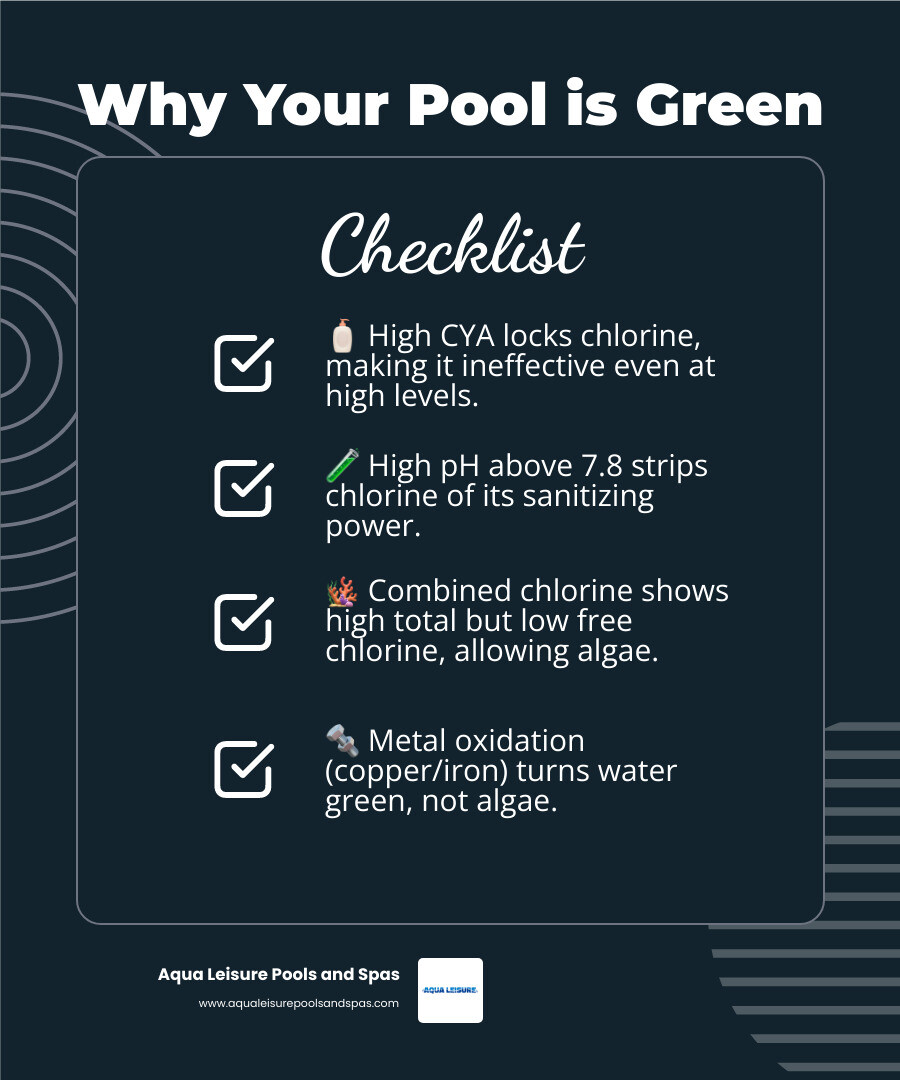
If your pool is green but chlorine is high, the problem is almost never a shortage of chlorine — it’s that your chlorine has stopped working.
Here’s why that happens, at a glance:
| Root Cause | What’s Going On |
|---|---|
| High CYA (chlorine lock) | Cyanuric acid binds chlorine, making it inactive |
| High pH | Above 7.8, chlorine loses most of its sanitizing power |
| Combined chlorine | Your “high” reading is spent chlorine, not active sanitizer |
| Metal oxidation | Copper or iron in the water turns it green, not algae |
| High phosphates | Algae has a food source chlorine alone can’t overcome |
| Filtration problems | Dead algae and debris never get removed from the water |
The frustrating truth is this: you can have a test strip showing chlorine in the “high” range and still have a swamp-green pool. That’s because high total chlorine doesn’t mean you have high free chlorine — the only form that actually kills algae.
There’s also a chemical trap that catches a lot of pool owners off guard. If you’ve been using stabilized chlorine tablets (trichlor) all season, your cyanuric acid (CYA) levels may have crept above 75 ppm. At that point, your chlorine is essentially locked up and unable to sanitize, no matter how much you add. At 80 ppm CYA, chlorine is only about 20% effective. At 150 ppm, it’s nearly useless.
And if you’re staring at clear green water — not cloudy, just tinted — the culprit may not be algae at all. Metals like copper or iron can oxidize and turn pool water a bright emerald green almost instantly after shocking, especially if you’re using well water or copper-based algaecides. Adding more chlorine in that situation makes the problem worse.
The good news: once you know which of these causes is behind your green water, the fix is straightforward.
Chlorine Lock: When Your Pool Is Green But Chlorine Is High
To understand why your pool is green despite showing high chlorine levels, we have to look closely at cyanuric acid (CYA). Often called “stabilizer” or “conditioner,” CYA acts like sunscreen for your chlorine. Without it, the harsh summer sun in Northeastern Pennsylvania would burn off your chlorine in a matter of hours.
However, CYA does not evaporate or break down. Every time you add stabilized chlorine—such as trichlor tablets in your chlorinator or dichlor shock bags—you are permanently adding more CYA to your water. Over a hot season in places like Wilkes-Barre or Scranton, these levels steadily creep upward.
When CYA levels exceed 75 ppm, a phenomenon known as “chlorine lock” occurs. The stabilizer binds so tightly to the chlorine molecules that it refuses to let them go. The chlorine is technically still in the pool (which is why your test kit shows a high reading), but it is chemically handcuffed. It cannot sanitize the water or kill invading algae spores.
At a standard 30 ppm of CYA, your chlorine is highly active and about 60% effective. Once you cross the critical 80 ppm threshold, that effectiveness plummets to 20% or less. The only reliable way to break this lock is through water dilution. You must partially drain a portion of your pool and refill it with fresh, unstabilized water to bring those stabilizer levels back down to a healthy 30 to 50 ppm range.
For a deeper dive into how stabilizer and other chemical additives interact in your water, explore How Do Pool Chemicals Work. If you suspect your stabilizer has completely bound up your sanitizer, you can read more about this phenomenon at Pool Green but Chlorine Is High? CYA Is Usually the Cause.
Algae vs. Metals: Diagnosing Why the Pool Is Green But Chlorine Is High
Before you dump more chemicals into your pool, you need to play detective. Is your green pool actually caused by organic algae, or is it a chemical reaction involving dissolved metals? Treating a metal problem with algae chemicals will only drain your wallet and worsen the discoloration.

The easiest way to tell the difference is by assessing the clarity of the water:
- Cloudy Green Water: If the water is murky, turbid, and the pool floor is hard to see, you are dealing with a classic algae bloom. The walls and floor of your pool might also feel slick or slimy to the touch.
- Clear Green Water: If the water is a sparkling, translucent, bottle-green or emerald color, and you can clearly see the drains at the bottom, the culprit is metal oxidation.
Metal contamination is incredibly common in areas of Pennsylvania where homeowners rely on well water, such as rural properties near Bartonsville or Lake Wallenpaupack. When well water containing dissolved iron or copper is added to a pool, it remains invisible until you introduce a strong oxidizer. The moment you add chlorine shock, the chlorine oxidizes the metals, turning the water green instantly.
Copper can also leach into your pool from low-grade copper-based algaecides or from the slow corrosion of copper heat exchangers in pool heaters. If metals are present, adding more chlorine will actually darken the green tint. Instead, you need a metal sequestering agent to bind the minerals and allow them to be filtered out.
To learn more about managing metal-induced discoloration, check out Can Too Much Chlorine Make Pool Cloudy or Green? – My Pool Calculator. If you have confirmed that organic algae is indeed the problem, you can find step-by-step guidance at The Best Way To Remove Algae From Your Pool Without Draining It.
The Role of pH and Phosphates in Chlorine Efficacy
Even if your CYA levels are perfect, two other sneaky chemical factors can render your chlorine useless: high pH levels and elevated phosphates.
Think of pH as the volume dial for your chlorine’s strength. When your pH climbs above 7.8, the water becomes highly alkaline, which dramatically alters the chemical structure of chlorine. Instead of remaining in its active, algae-killing form (hypochlorous acid), it dissociates into a lazy, inactive form (hypochlorite ion). At a pH of 8.0, chlorine operates at less than 20% of its normal disinfecting power. You could have a massive amount of chlorine in the pool, but the high pH completely neutralizes its ability to fight off organic invaders.
At the same time, phosphates may be acting as an all-you-can-eat buffet for algae. Phosphates are phosphorus compounds that enter your pool through wind-blown dirt, lawn fertilizers, decaying leaves, and heavy summer rainstorms.
While phosphates do not directly turn your pool green, they act as a supercharged food source. If your phosphate levels climb above 300 to 500 ppb (parts per billion), algae can multiply faster than your chlorine can kill it. When chlorine eventually kills an algae cell, that dead cell ruptures and releases its stored phosphates back into the water, feeding the next generation of spores. This creates a frustrating, endless cycle of recurring green water.
To understand how these parameters interact, read Pool Chlorine High But Water Is Still Green: Why It Happens and How to Fix It – Pool Chemical Calculator. For practical tips on keeping your water balanced, consult What Are Ph Levels and learn about the importance of alkalinity buffers at What Is Alkalinity And How Does It Affect Your Pool.
Free Chlorine vs. Combined Chlorine vs. Total Chlorine
One of the most common mistakes pool owners make is relying on basic test strips that only measure “Total Chlorine.” To properly diagnose a green pool, you must understand the difference between the three types of chlorine:
- Free Chlorine (FC): This is the active, unused sanitizer that is floating freely in your pool, ready to attack algae, bacteria, and organic contaminants.
- Combined Chlorine (CC): Also known as chloramines, this is chlorine that has already bound to contaminants and is spent. It is no longer effective at sanitizing, and it is the actual cause of that strong “chlorine smell” and eye irritation.
- Total Chlorine (TC): This is simply the sum of your Free Chlorine and Combined Chlorine (FC + CC = TC).
| Chlorine Type | Optimal Maintenance Range | Purpose in Your Pool |
|---|---|---|
| Free Chlorine (FC) | 1.0 – 3.0 ppm | Active sanitizer that actively kills algae and pathogens. |
| Combined Chlorine (CC) | Under 0.5 ppm | Spent chlorine. High levels indicate a need to shock the pool. |
| Total Chlorine (TC) | Equal to Free Chlorine | The total sum of both active and spent chlorine in the water. |
If your test kit only measures Total Chlorine, you might see a “high” reading of 5.0 ppm and assume your pool is safe. However, if your Free Chlorine is 0.5 ppm and your Combined Chlorine is 4.5 ppm, your pool has virtually no sanitizing power left. The algae is winning because your chlorine is already used up.
To get an accurate picture, you should use a high-quality DPD or FAS-DPD drop test kit, which allows you to measure Free Chlorine and Combined Chlorine independently. For more details on diagnosing chlorine types, read Pool Is Green but Chlorine Is High? Causes and Fixes Explained – Beatbot. To master the art of water analysis at home, see our guide on Testing Your Pool Water.
How to Fix a Green Pool with High Chlorine in 5 Steps
If your pool is green despite showing high chlorine levels, follow this systematic, step-by-step restoration process to reclaim your clear water.
Steps 1-3: Test, Dilute CYA, and Balance pH
Step 1: Perform a Comprehensive Water Test
Before adding a single scoop of shock, you must know your exact starting numbers. Avoid cheap, expired test strips. Use a reliable liquid drop test kit to measure your Free Chlorine, Total Chlorine, pH, Total Alkalinity, and Cyanuric Acid.
Step 2: Dilute Your Water if CYA Is Too High
If your CYA reading is above 75 ppm, your pool is in chlorine lock. There is no chemical shortcut to lower stabilizer. You must drain 25% to 50% of your pool water and refill it with fresh water. Note: If you live in areas with high water tables in Northeastern Pennsylvania, avoid draining your pool completely, as hydrostatic pressure can cause the pool shell to lift or “pop” out of the ground. Partial draining is always the safer path.
Step 3: Balance Your Alkalinity and pH
Once your CYA is in the ideal 30 to 50 ppm range, adjust your Total Alkalinity first (aiming for 80 to 120 ppm), as this stabilizes your pH. Next, lower your pH to between 7.2 and 7.4 using muriatic acid or sodium bisulfate. Keeping your pH on the lower end of the acceptable range dramatically boosts the sanitizing strength of the chlorine you are about to add.
For professional advice on selecting the right testing gear, check out My Pool Is Green But Chlorine Is High – What Do I Do? and explore our recommended testing products at 5 Best Chemicals To Test The Pool.
Steps 4-5: Shock, Filter, and Vacuum the Pool
Step 4: Brush the Pool and Apply Unstabilized Shock
Algae protects itself with an invisible, slick biofilm. You must vigorously brush the walls, steps, and floor of your pool to break this protective barrier, allowing chlorine to make direct contact with the algae cells.
Once brushed, shock the pool at dusk. Always use an unstabilized chlorine shock, such as calcium hypochlorite (cal-hypo) or liquid chlorine, so you do not accidentally raise your CYA levels again. For a moderate algae bloom, you will want to raise your Free Chlorine level to at least 20 to 30 ppm, maintaining that level until the green color fades.
Step 5: Run Continuous Filtration and Vacuum to Waste
Your filtration system accounts for roughly 80% of your pool’s maintenance effectiveness. Once the shock kills the algae, your water will transition from bright green to a cloudy, grey-blue. This is a great sign—it means the algae is dead, but now those microscopic dead particles are suspended in your water.
Run your pool pump 24/7. Monitor your filter pressure closely and backwash sand filters or hose down cartridge filters whenever the pressure rises 8 to 10 psi above your clean baseline. If the dead algae settles to the floor, hook up your manual vacuum, set your multiport valve to “Waste,” and vacuum the sediment directly out of the pool to prevent clogging your filter.
To ensure you have the right gear and filtration setup, read Why Is My Pool Green? Causes And How To Fix It and learn about system upkeep at How To Maintain Your Pools Filtration System. For a list of the must-have products to keep your pool clear, visit Stop The Green The Must Have Chemicals For A Crystal Clear Pool.
If your current filter is struggling to keep up with heavy debris, it might be time for an upgrade. Explore high-efficiency equipment options at Stop Playing Tag With Algae With These Sand Filter And Saltwater Combos.
Essential Tools for Pool Clearing
- High-quality liquid drop test kit (FAS-DPD preferred)
- Stiff pool brush (nylon for vinyl liners, stainless steel for concrete/plaster)
- Unstabilized liquid chlorine or calcium hypochlorite shock
- Manual vacuum head, hose, and vacuum pole
- Phosphate remover (if levels exceed 300 ppb)
- Metal sequestering agent (if clear green water indicates metal oxidation)
By following these five steps, most residential pools will clear up beautifully within 48 to 72 hours. If you need hands-on assistance, professional water testing, or high-quality chemicals, the team at Aqua Leisure Pools and Spas is always ready to help you restore your backyard oasis at any of our showrooms in Doylestown, Dickson City, Wilkes-Barre, and Bartonsville.
Posted by Aqua Leisure Pools in Pools