


Low-Voltage Illumination: A Practical Guide to 12V Swimming Pool Lights

How to Choose 12V Swimming Pool Lights
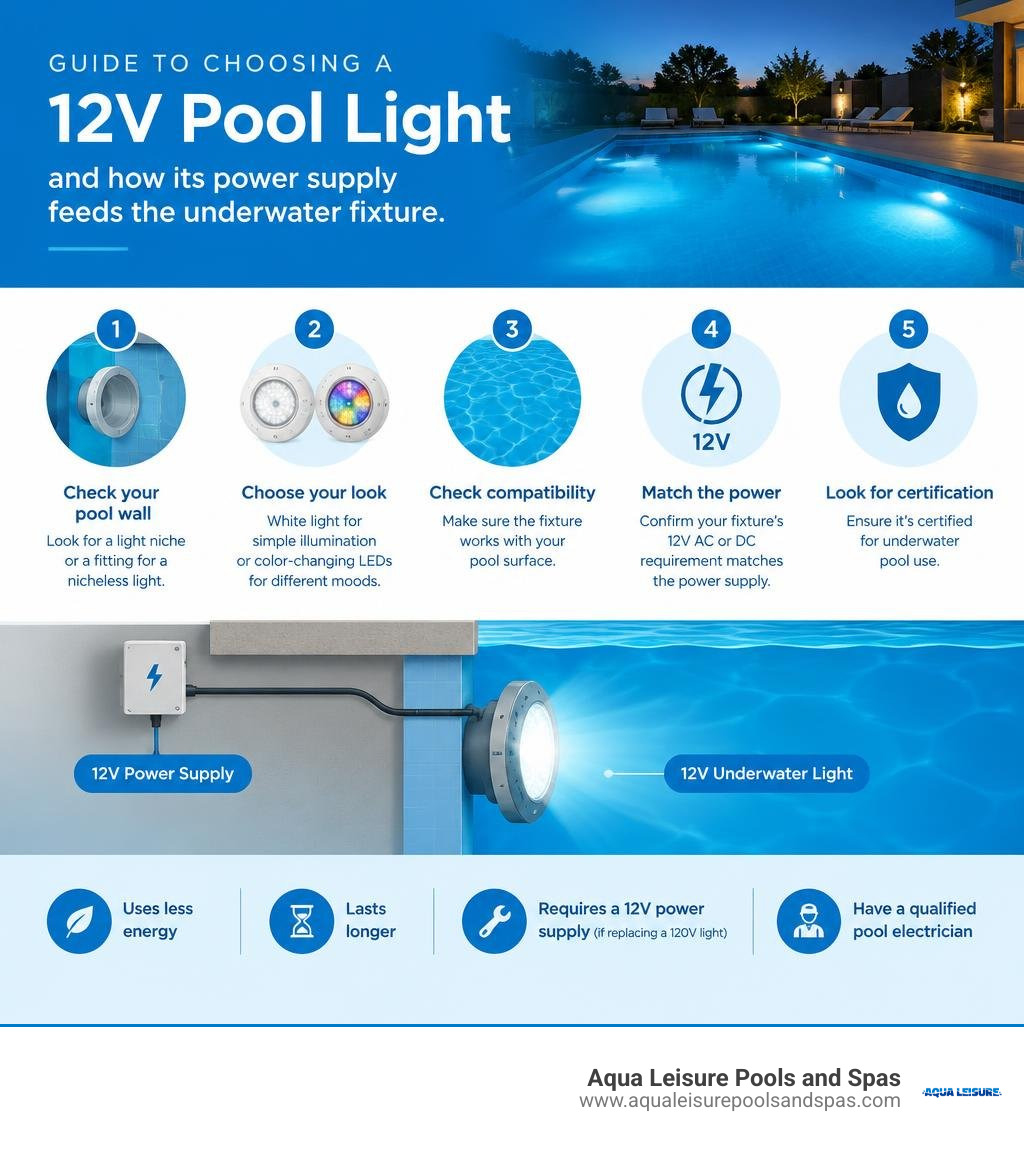
To choose 12v swimming pool lights, start with your pool wall. Check whether it has a light niche or a fitting for a compact, nicheless light. Then choose white light for simple illumination or color-changing LEDs for different moods. Before buying, confirm that the fixture works with your pool surface, that its 12V AC or DC power requirement matches the power supply, and that it is certified for underwater pool use.
LED lights can use less energy and last longer than older incandescent fixtures. If you are replacing a 120V light, the upgrade also needs a suitable 12V power supply and a check of the existing niche and wiring. Have a qualified pool electrician handle that work so the finished space is both inviting and safe.
Terms related to 12v swimming pool lights:
Why Upgrade to 12V Swimming Pool Lights: Safety, Efficiency, and Fixture Types
Modern swimming pool design emphasizes energy efficiency, user safety, and customizable backyard aesthetics. Traditional high-voltage incandescent pool fixtures operate directly on standard household electrical current. While these heavy fixtures illuminated backyards for decades, low-voltage systems have become the gold standard.
By operating on a safe 12-volt current stepped down from the main electrical line, low-voltage underwater lighting eliminates high-voltage power lines running into the water. In addition, solid-state LED technology pairs seamlessly with 12V power to deliver vibrant color and crisp visibility with a fraction of the power consumption.
Core Benefits of 12V Swimming Pool Lights Over 120V Systems
The most critical reason pool owners choose low-voltage systems is electrical safety. Stepping down 120V household electricity to 12V at an external transformer substantially reduces the risk of electrical shock hazards in the water. For new pool installations, low-voltage lighting is widely recognized as the safest choice.
Beyond safety, modern 12V LED fixtures are exceptionally durable and economical. High-efficiency LED pool lights are rated for up to 50,000 hours of operation. In contrast, older incandescent lamps often burn out after 2,000 to 5,000 hours. Because incandescent bulbs rely on a fragile, glowing metal filament, roughly 90% of their energy is lost as heat. LED fixtures remain cool to the touch and use far less power.
Understanding everything you need to know about swimming pool lights makes it easy to see the massive performance gap between legacy and modern options:
| Feature | 12V Low-Voltage LED Fixture | Legacy 120V Incandescent Fixture |
|---|---|---|
| Operating Voltage | 12V AC or 12V DC (via transformer) | 120V AC (direct line power) |
| Power Consumption | 7W – 40W | 300W – 500W |
| Expected Lifespan | Up to 50,000 hours | 1,000 – 5,000 hours |
| Energy Savings | Up to 80% to 90% reduction | Baseline high power draw |
| Color Versatility | Millions of shades, solid colors, and light shows | Single warm white (requires physical snap-on colored lenses) |
| Heat Output | Low operating temperature | High thermal output |
Advanced engineering allows modern fixtures to optimize light output even further. For example, options like the Pentair IntelliBrite 5G use specialized reflector and lens geometries that consume up to 50% less energy than competing lights while providing wide, balanced beam diffusion without hot spots.
Exploring Fixture Styles: Niche, Nicheless, and Compact Lighting
Low-voltage pool lights come in several structural designs to fit different pool layouts:
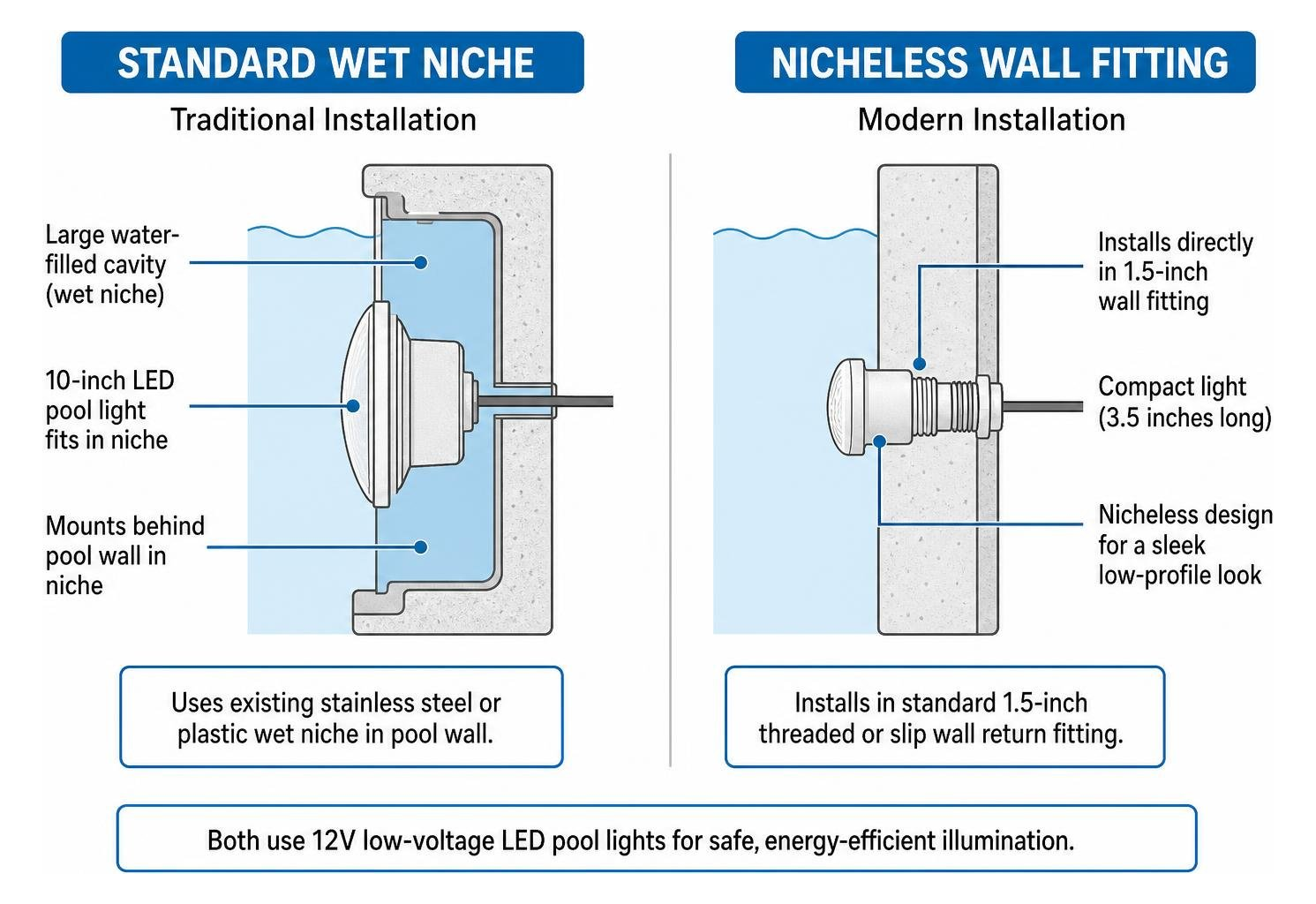
- Standard Wet Niche Fixtures: Traditional inground pools house light fixtures inside large water-filled cavities built into the wall, known as wet niches. Modern 12V LED replacement fixtures, such as standard 10-inch models, fit into existing stainless steel or plastic niches. Upgrading to vibrant 8 inch pool lighting allows homeowners to illuminate deep swim zones using their existing pool infrastructure.
- Nicheless and Compact 1.5-Inch Wall Fitting Lights: Modern pool design often favors sleek, nicheless luminaires. Instead of requiring a bulky wall bucket, these fixtures install directly into a standard 1.5-inch threaded or slip wall return fitting. Compact models like the Pentair 620424 MicroBrite measure only 3.5 inches long and consume just 12 to 14 watts at 12 volts. Available in configurations like the Pentair 620425 with a 100-foot cord or the Pentair MicroBrite 620430 with a 150-foot cord, these compact lights are perfect for narrow pool walls, sun shelves, baja benches, swim-outs, and steps where traditional fixtures cannot fit.
- Through-Wall Fixtures for Above Ground Pools: Low-voltage lighting is not limited to inground installations. Reviewing the complete guide to above ground through wall pool lights shows how compact low-voltage systems mount through vinyl pool walls to provide uniform nighttime illumination for above ground pools.
Color-Changing Modes, Shows, and Smart Control Options
Modern 12V LED lighting turns a backyard pool into a visual showcase. Fixtures built with RGBW (red, green, blue, white) LED arrays allow owners to select pure monochrome hues or dynamic, multi-color transitions.
Controlling these lighting effects is straightforward, with several options available:
- Toggle Switch Control: Many 12V lights do not require a separate controller. Fixtures like the PoolTone 16-color LED pool light allow users to advance through 16 color choices and light shows simply by toggling the standard wall light switch off and on within an 8-second window. Integrated memory functions store the last active color setting, so the pool returns to your preferred shade every time it turns on.
- Dedicated Wireless Controllers and Remotes: Some systems come equipped with handheld radio-frequency remotes. These allow direct selection of specific colors, brightness dimming, and light show speed adjustments from the pool deck.
- Smart Pool Automation Systems: High-end 12V fixtures, including the Pentair IntelliBrite 5G EC-602124, interface with digital pool automation panels. This allows pool owners to program lighting schedules, synchronize pool and spa colors, and adjust backyard ambiance using a smartphone app or voice commands.
Consulting a guide to colored pool lights helps pinpoint which color-changing sequences best fit your entertaining style.
Buyer and Installation Guide for Low-Voltage Pool Illumination
Choosing the correct 12V lighting setup involves evaluating pool construction materials, total transformer capacity, cord lengths, and waterproof installation methods.
Sizing and Selecting 12V Swimming Pool Lights for Your Pool Surface
Different pool interior surfaces absorb and reflect light in distinct ways:
- White Plaster and Light Gunite: These surfaces reflect light exceptionally well. A single 40W 12V LED fixture or a pair of compact nicheless lights can comfortably illuminate pools up to 30 to 40 feet in length.
- Dark Plaster, Pebble, and Quartz Finishes: Darker finishes absorb up to 50% more light energy than white plaster. To achieve bright, even illumination, plan for multiple fixtures or higher-lumen LED lights spaced closer together.
- Vinyl Liners and Fiberglass Shells: Vinyl liners with light blue patterns reflect light smoothly, while deep blue or geometric patterns may require higher output. Fixtures like the 7-watt S.R.Smith kēlo LED pool light operate on 12VAC and include interchangeable trim rings to blend seamlessly with vinyl, fiberglass, or concrete surfaces.
Following a reliable checklist for buying a compatible 12v pool light and reviewing a cheat sheet to best pool lights for inground pools ensures your fixture matches your pool’s specific finish and dimensions.
Transformer Requirements, Wiring, and 120V Retrofitting
When converting an older 120V light niche to a 12V LED system, you cannot connect 120V line voltage directly to the fixture. Doing so will immediately damage a low-voltage light. A safety-rated step-down transformer must be installed between the electrical breaker panel and the underwater light fixture.
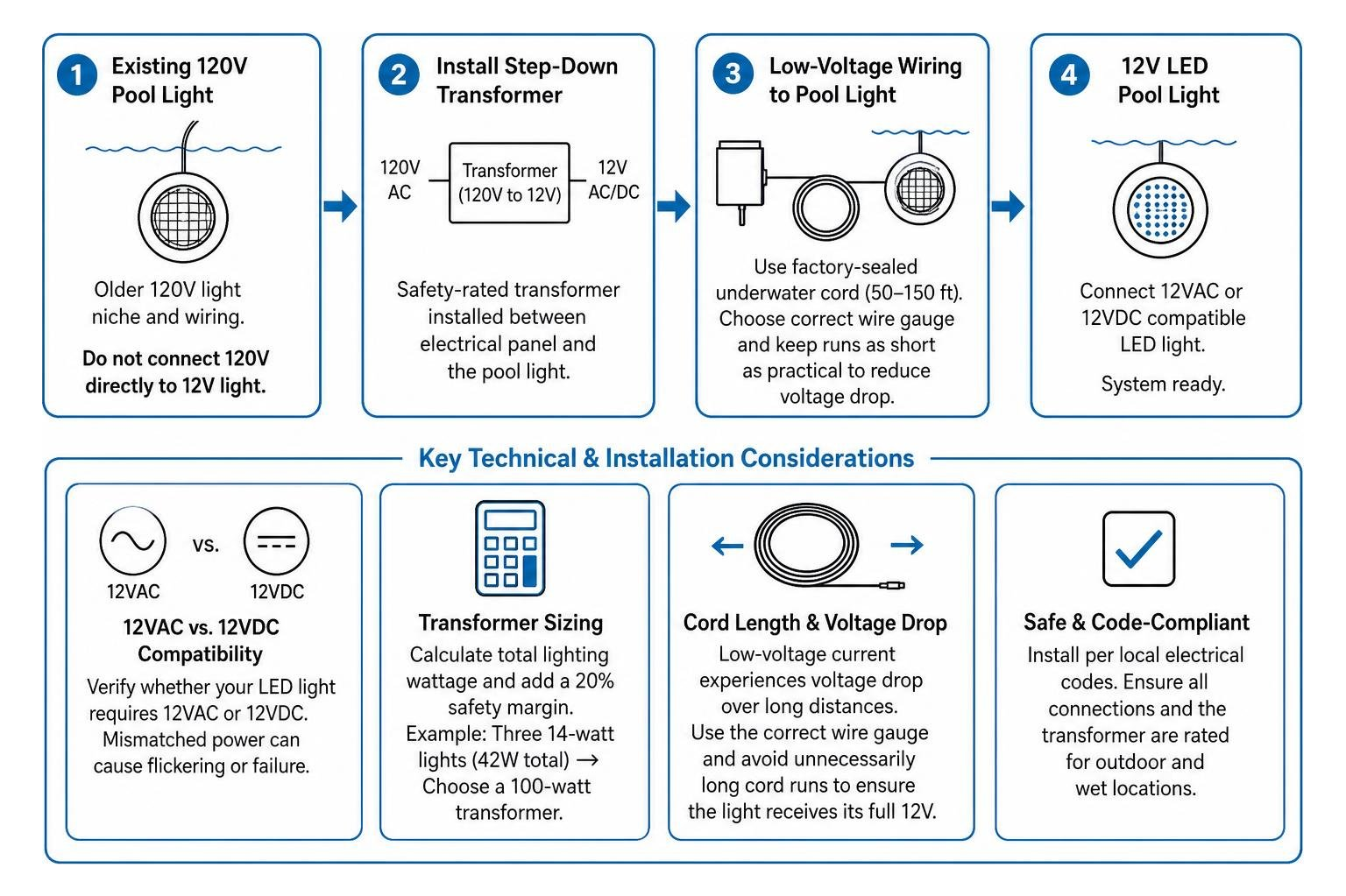
Key technical and installation considerations include:
- 12VAC vs. 12VDC Compatibility: Always verify whether your LED light requires alternating current (12VAC) or direct current (12VDC). Connecting an AC-only fixture to a DC driver (or vice versa) can cause flickering or fixture failure.
- Transformer Sizing: To protect your transformer and prevent voltage drops, calculate total lighting wattage and add a 20% safety margin. If you are powering three 14-watt nicheless lights (totaling 42 watts), a 100-watt pool transformer provides ample capacity.
- Cord Length and Voltage Drop: Pool lights feature factory-sealed underwater power cords ranging from 50 to 150 feet. Because low-voltage current experiences voltage drop over long electrical distances, choose the correct wire gauge and avoid unnecessarily long cord runs to ensure the light receives its full 12V supply.
- Pulling the Cord Through Conduit: When feeding a new light cord through underground conduit, apply a water-soluble, silicone-based lubricant. Never use petroleum-based lubricants, which degrade wire insulation and damage pool filtration systems.
For budget-conscious homeowners, reading a smart buyer guide to affordable inground pool lights and reviewing pool lights installation procedures simplifies the retrofitting process.
Safety Standards, Certifications, and Professional Installation
Underwater electrical equipment must meet strict safety testing. When purchasing 12V pool lighting, look for the following certifications on the product specification sheet:
- UL676 and ETL Listings: Confirms the fixture is tested and certified specifically for underwater swimming pool and submersible luminaire standards in North America.
- IP68 Waterproof Rating: Ensures the light housing is completely hermetically sealed and potted against water intrusion at continuous submersion depths.
- Bonding and Grounding Standards: Many modern all-plastic, nicheless low-voltage LED lights do not require external earth bonding, saving significant installation labor while meeting national electrical code requirements.
Most reputable 12V LED manufacturers offer 1- to 3-year limited warranties, provided the lights are installed according to manufacturer specifications with a compatible low-voltage power supply.
Homeowners across Northeastern Pennsylvania—including Scranton, Wilkes-Barre, Dickson City, Doylestown, Bartonsville, Allentown, Bloomsburg, and Lake Wallenpaupack—can rely on Aqua Leisure Pools and Spas. As a one-stop destination, they sell, install, and maintain quality pools and spas to help customers build their dream backyard. Visit our pool showrooms or explore our expert in-ground pools design services to find the perfect low-voltage lighting system for your pool.
Frequently Asked Questions
Can I replace my existing 120V pool light with a 12V LED light?
Yes. You can install a 12V LED light into an existing niche or wall fitting, but you must install an external 120V-to-12V step-down transformer at your equipment pad between your breaker and the light fixture.
What is the lifespan of a 12V LED swimming pool light?
High-quality 12V LED pool lights are rated for up to 50,000 hours of operation. Under standard residential use, a single LED fixture can provide reliable illumination for over a decade.
Is a 12V pool light as bright as a 500W incandescent bulb?
Yes. Modern LED pool lights use efficient solid-state arrays and optical lenses to produce lumen output equivalent to a 300W to 500W incandescent lamp while consuming between 12W and 40W of electricity.
What happens if I connect a 12V pool light directly to 120V power?
Connecting a 12V pool light directly to standard 120V household power will instantly burn out the internal LED components and permanently damage the fixture. Always use an approved 12V step-down transformer.
Posted by Aqua Leisure Pools & Spas in Pools